The Seesaw
Francisco Goya, 1779
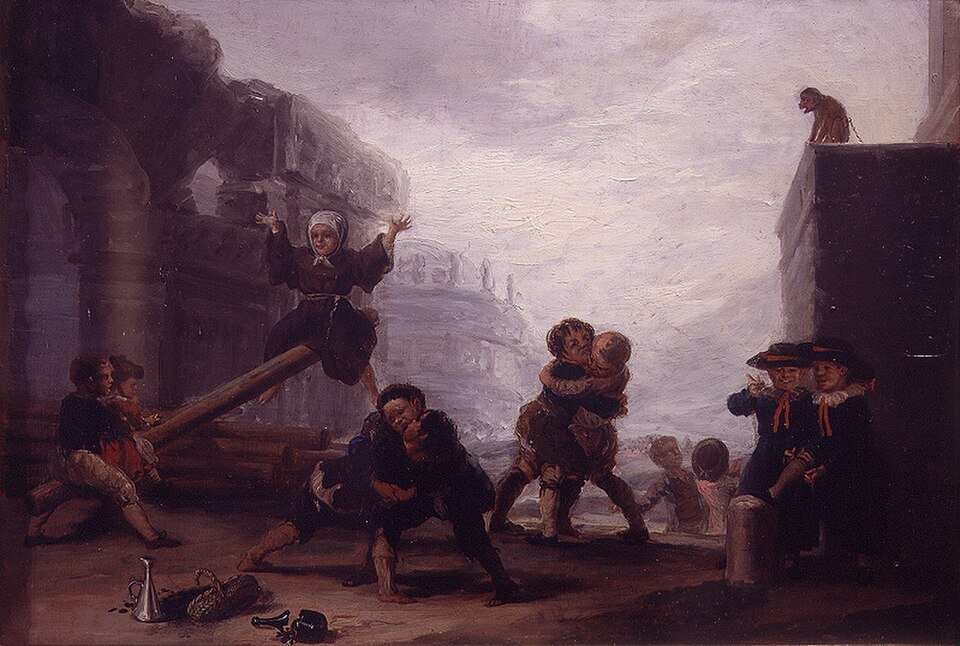
The Seesaw is a small oil on canvas showing two children fighting over a seesaw beside a city wall. The scene captures the moment when play becomes more intense: the children grow absorbed in their game and struggle to climb onto the seat, rendered with an everyday charm that differs from the more solemn subjects of the period. The painting is traditionally linked to the fourth series of tapestry cartoons Goya produced for the Palacio del Pardo, specifically for the bedroom of the Prince and Princess of Asturias. That connection, however, is not unanimously accepted: many scholars doubt it belongs to the group, because during those years the painter also produced a series of five canvases on children's themes, among them The Lesson of Blood Entering, which shares many details with this work. One argument in favour of its membership is that the cartoons were kept in a basement of the Royal Palace in Madrid, where this canvas was also stored, a detail some researchers regard as a sign of its origin. More striking is the purpose of those childhood paintings. It is unknown why Goya made them once he had finished his period as a cartoon painter and enjoyed greater freedom. They may have been intimate works meant to ease the pressure of his commissions, or preparatory studies for later projects. Either way, his interest in childhood remained constant in his early career, and The Seesaw shows with ease that attentive gaze on play and domestic life that characterised much of his early output.
- Painter
- Francisco Goya
- Date
- 1779
- Medium
- oil paint, canvas
- Dimensions
- 31 × 43 cm
- Museum
- Museu de Belles Arts de València, Valencia
More works by Francisco Goya


