Temptation of Adam
Jacopo Tintoretto, 1550
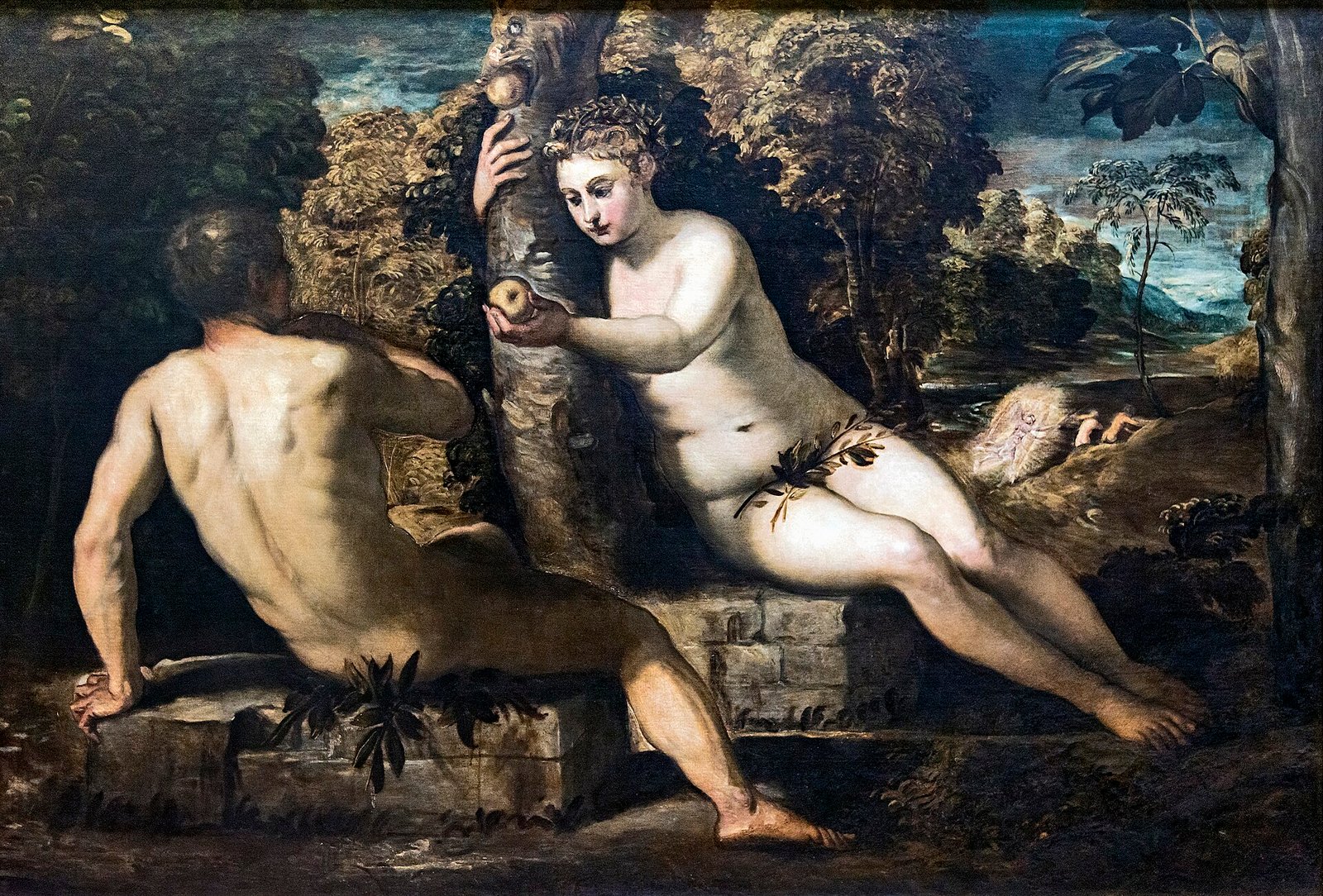
The Fall of Man, known in English also as The Temptation of Adam, is one of the best-known works by Tintoretto and is usually dated to around 1550, during his early Venetian career. It shows the moment when Adam and Eve, the first human couple, succumb to temptation as told in the Book of Genesis. The subject was very popular in European painting and is one of the few Old Testament episodes that present a naked man and woman side by side. The composition is built around the tree of knowledge, which stands at the centre, with the two figures seated on a low semicircular wall around it. Eve, on the left and slightly higher, leans against the trunk with her eyes fixed on the apple in her hand, while the tempter appears above as an animal head holding another fruit in its mouth. Adam, on the right and seen from behind, props himself up on his left hand and turns towards her in a hesitant, pensive pose. Placing a figure with his back to the viewer was unusual for the period. In the background, a small scene shows what follows: the expulsion from Paradise, pursued by an angel with a flaming sword. The painting stands out for combining a nude modelled on antique sculpture with a strong knowledge of the human body and of nature. Its landscapes, however, depart from the manner of Titian and point towards a more poetic sensibility, which is why the work is often regarded as a notable forerunner of later developments in art.
- Painter
- Jacopo Tintoretto
- Date
- 1550
- Medium
- oil paint, canvas
- Dimensions
- 150 × 220 cm
- Museum
- Gallerie dell'Accademia, Venice
- Movement
- Venetian school
- Genre
- religious art, nude
- Depicts
- nudity, sitting, back, fig leaf, broad-leaved tree, Garden of Eden, trunk, couple
More works by Jacopo Tintoretto


