St Mark's Body Brought to Venice
Jacopo Tintoretto, 1564
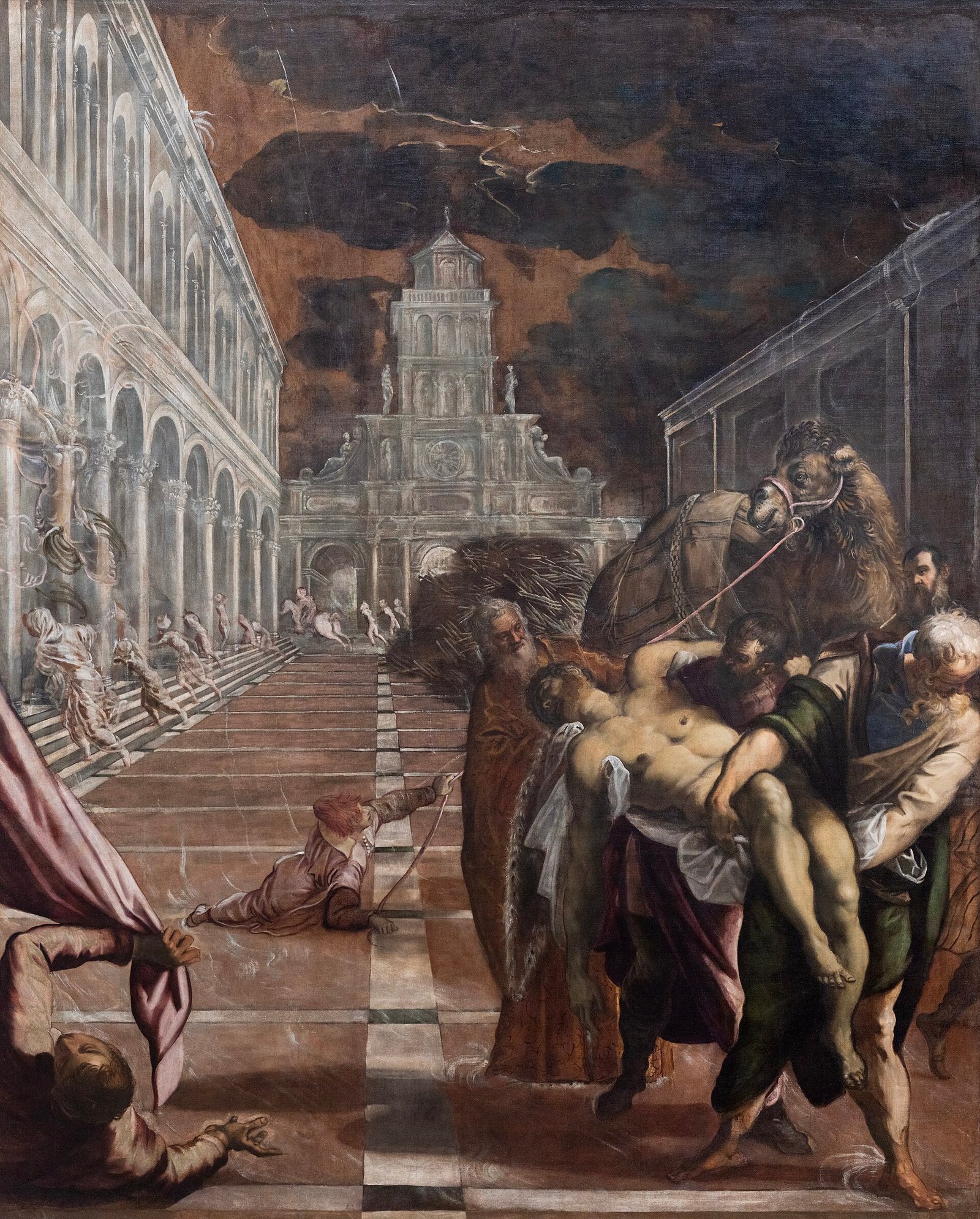
Tintoretto painted this work around 1564 as part of a group of canvases for the Scuola Grande di San Marco in Venice, all devoted to the evangelist who was the city's patron. It shows the transfer of his relics from Alexandria, where tradition holds that Mark preached, to Venice, an event the legend places in 828. The best-known account tells how sailors who took the body out of Egypt hid it under pork and vegetables to evade the guards, and the painting conveys the clandestine, almost furtive character of that removal.
The composition is notable for its deep, striking perspective. The nearest figures are rendered in darker, stronger colours, while those in the distance turn pale and almost transparent. The square is narrow and elongated, recalling St Mark's Square in Venice, so that an Egyptian city ends up looking much like the painter's own. The reddish sky, crossed by grey clouds and a lightning bolt, gives the scene a tense, restless atmosphere, as though the events unfold in the middle of a storm.
Among the figures, the bearded man beside the camel is usually identified as Tintoretto himself, a discreet presence through which the artist placed himself inside his own narrative. The people fleeing to one side and the group carrying the body to the other create a diagonal movement across the picture.
The work matters for the way it joins a religious story with an almost theatrical handling of space, a trait typical of Venetian Mannerism, and for its role in a cycle commissioned to celebrate the identity of the city. It is now in the Gallerie dell'Accademia in Venice.
- Painter
- Jacopo Tintoretto
- Date
- 1564
- Medium
- oil paint, canvas
- Dimensions
- 398 × 315 cm
- Museum
- Gallerie dell'Accademia, Venice
- Movement
- Mannerism, Venetian school
- Genre
- religious art
- Depicts
- Mark the Evangelist, archway, column, corpse, Venice
More works by Jacopo Tintoretto


