Last Supper
Jacopo Tintoretto, 1563
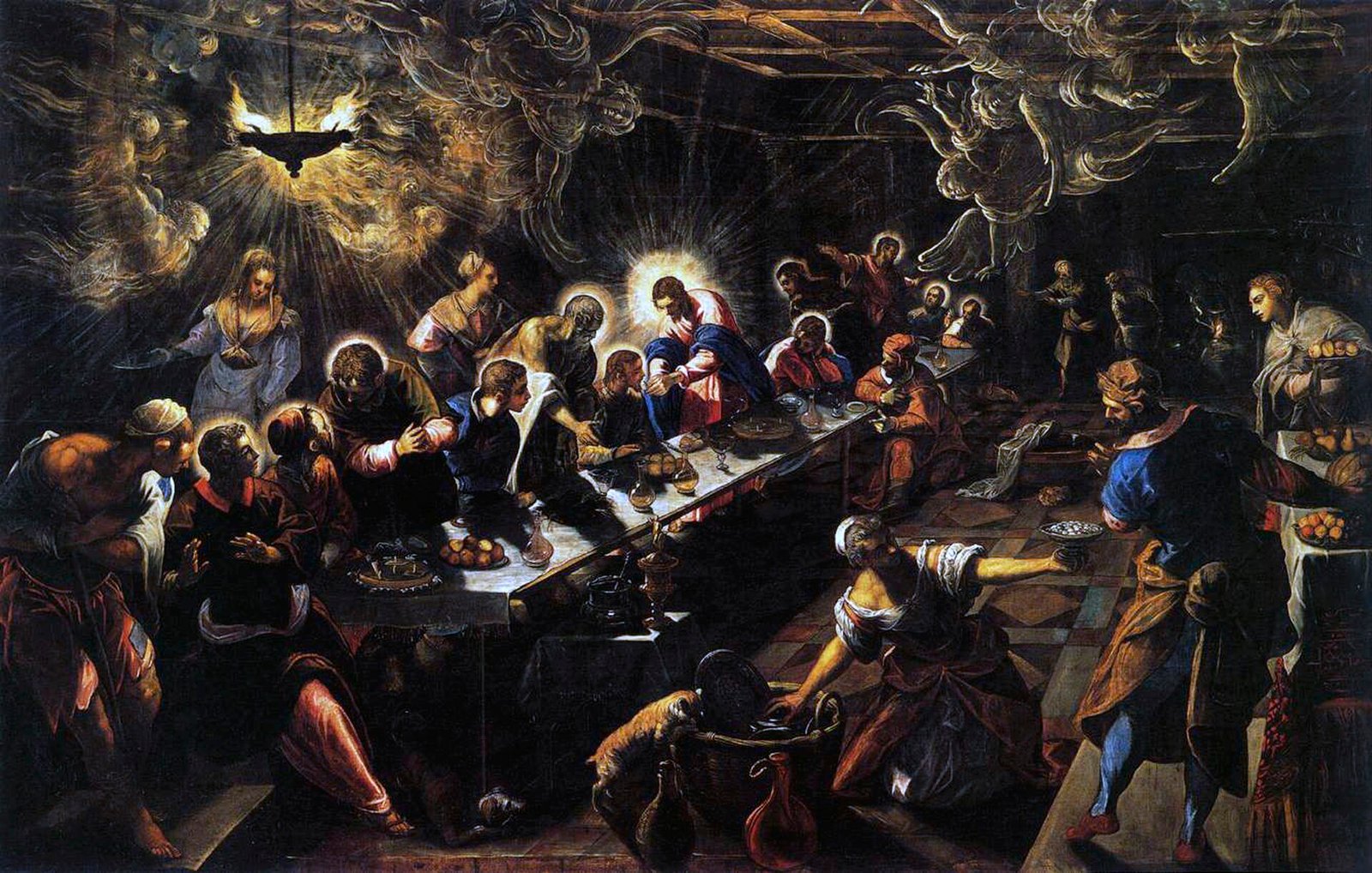
Tintoretto painted The Last Supper around 1592–1594, late in his career, and it hangs today in the basilica of San Giorgio Maggiore, on an island in Venice, where it was probably placed on a wall of the presbytery alongside other works from the same years. The subject was a staple of Catholic religious painting, and the artist had treated it several times before, using a frontal, orderly arrangement of the kind Leonardo da Vinci made famous. Here that order breaks down. The table where the apostles sit runs back into depth on a steep diagonal, and the centre of the canvas is taken not by Christ but by secondary figures, such as a woman carrying a dish and servants clearing the table. The apostles seem crowded in and overwhelmed by what is happening around them, and above them hover angels that look luminous and almost transparent, adding a visionary note to a scene that otherwise resembles a busy tavern at night. Light is one of the painting's most striking features. The canvas is dark, and the faces are picked out mainly by the glow of the saints' haloes. Two areas of strong light stand out: the lamp hanging from the ceiling at upper left and the halo around Christ. This uneven illumination draws attention to incongruous details and gives the scene an unsettling air. The composition combines Mannerist devices, such as its complexity and asymmetry, with a dynamism and interest in everyday life that look ahead to the Baroque, which is why the work is often seen as a bridge between the two styles. Its dramatic force also fits the Counter-Reformation belief that religious images should teach and move the viewer.
- Painter
- Jacopo Tintoretto
- Date
- 1563
- Medium
- oil paint, canvas
- Dimensions
- 365 × 568 cm
- Museum
- Church of San Giorgio Maggiore, Venice
- Movement
- Mannerism, Venetian school, Proto-Baroque
- Genre
- religious art
- Depicts
- lamp, dog, cat, table, basket, cup with stem, drinking glass, angel
More works by Jacopo Tintoretto


