Finis Gloriae Mundi
Juan de Valdés Leal, 1670
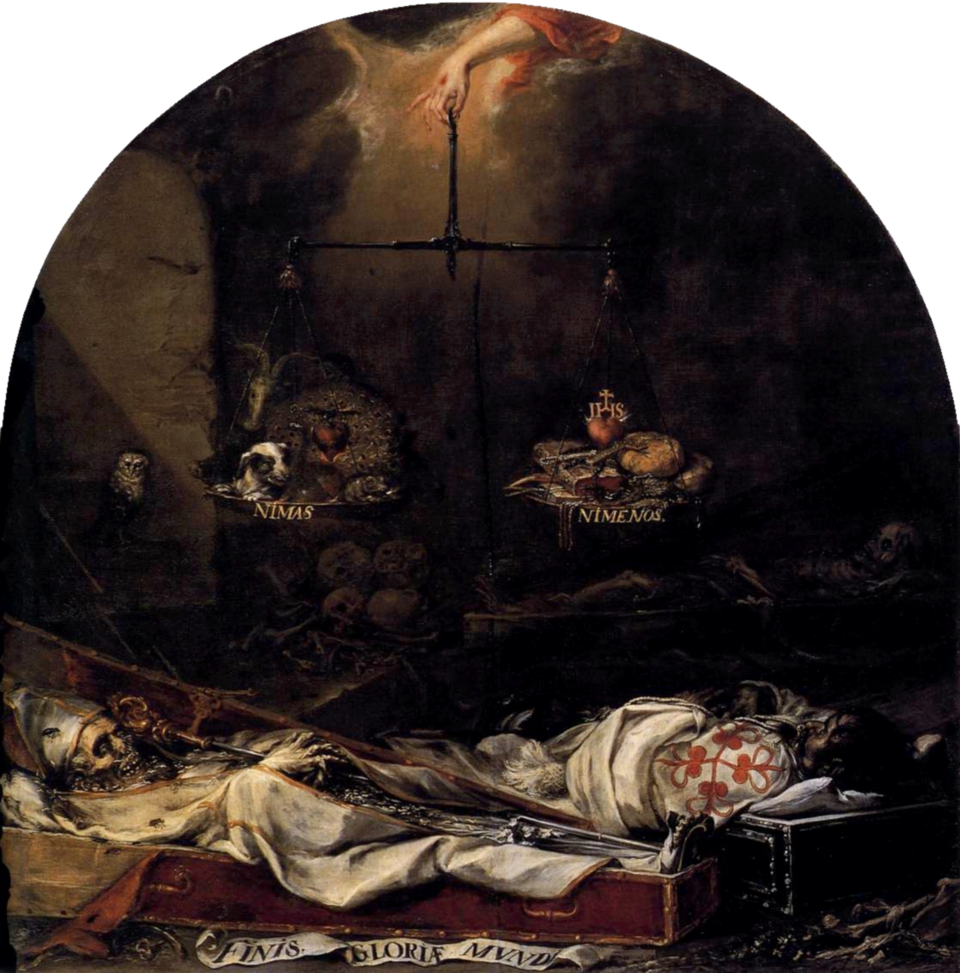
Finis Gloriae Mundi is one of two large memento mori paintings that Juan de Valdés Leal produced around 1670 for the Hospital de la Santa Caridad in Seville, commissioned by Miguel de Mañara, the institution's founder. Both were placed beneath the church choir and were meant to remind viewers of the transience of earthly goods, a theme common in Baroque vanitas painting.
The scene is arranged in three planes. In the foreground lie two corpses in open coffins: a bishop, identifiable by his liturgical vestments, and a knight of the Order of Calatrava wrapped in his cloak, who is traditionally identified as Mañara himself. Above them, a hand emerging from clouds holds a scale whose pans carry the capital sins, shown through animals and objects, set against the virtues. The inscriptions "ni más" and "ni menos" (neither more nor less) make the meaning of the judgement explicit. In the background, an owl and skulls deepen the atmosphere of darkness.
The work stands out for its tenebrism, with strong light and shadow that draw attention to the bodies and the illuminated hand. Its purpose is best understood within the Counter-Reformation context of Seville, a city devastated by plague, where confraternities devoted to burying the poor and abandoned were flourishing.
- Painter
- Juan de Valdés Leal
- Date
- 1670
- Medium
- oil paint, canvas
- Dimensions
- 220 × 216 cm
- Museum
- Hospital de la Santa Caridad, Seville
More works by Juan de Valdés Leal