
Ivan Shishkin
1831–1898 · Russian Realist landscape painter, draughtsman and founding member of the Peredvizhniki
Ivan Ivanovich Shishkin (Yelabuga, 1832 – Saint Petersburg, 1898) was one of the most distinguished landscape painters of Russian Realism in the nineteenth century. A founding member of the Peredvizhniki, the Society for Traveling Art Exhibitions, he is remembered above all for his forest scenes of pines, birches and oaks, painted with a precision that blends close observation of nature with a poetic sensibility. His importance lies in bringing the Russian forest, and the changing seasons within it, to the centre of the country's painting. Sources differ on his year of birth, which is given as either 1831 or 1832; 1832 is the date most commonly cited.
Childhood and early schooling
Shishkin was born in Yelabuga, in the Vyatka Governorate, now within the Republic of Tatarstan. He came from a family of local merchants: his father was a grain merchant, and his grandfather had been a palace peasant who was registered as a merchant in the town. At the age of twelve he was enrolled in the First Kazan Boys' Gymnasium. After about five years there he returned to Yelabuga, where he spent four more years. In 1852 he entered the Moscow School of Painting, Sculpture and Architecture, where he studied until 1856.
Training in Saint Petersburg
After finishing in Moscow he continued at the Imperial Academy of Arts in Saint Petersburg, from 1857 to 1860, as a pupil of the landscape painter Sokrat Vorobyov. There he formed a close friendship with two like-minded classmates, Aleksander Gine and Pavel Jogin. Together they worked at Dubki, a small settlement on the shore of the Gulf of Finland, and later travelled to Valaam Island on Lake Ladoga, home to its celebrated monastery. These trips sharpened his ability to render nature accurately, in both brush and pencil. His awards rose steadily: first two small silver medals, for a view of the outskirts of Saint Petersburg and for summer drawings, then a large silver medal for a study of a pine on Valaam, and finally, in 1860, the large gold medal for two paintings of Valaam Island.
Years abroad
The gold medal carried a scholarship for travel abroad. In 1861 he was in Munich, where he visited the studios of Benno Adam and Franz Adam, both highly regarded as animal painters. In 1863 he moved to Zurich, where he worked under Rudolf Koller, then considered one of the finest animal painters in Europe, sketching and painting animals from life. It was in Zurich that he first experimented with etching using aqua regia, a technique he would practise for the rest of his life. He went on to Geneva to study the work of François Diday and Alexandre Calame, and in 1864 to 1865 he attended the Düsseldorf Art Academy. There he painted a view of the city's surroundings on commission for the collector N. Bykov, a work that earned him the title of academician of the Imperial Academy. Abroad he also produced pen drawings that impressed foreign audiences, and some were shown at the Düsseldorf Museum alongside work by masters such as Andreas Achenbach and Karl Friedrich Lessing.
Return to Russia and the Peredvizhniki
Homesick, he returned to Saint Petersburg in 1866, before his scholarship had run its full term. From then on he travelled widely across Russia in search of subjects and exhibited at the Academy almost every year. In 1868 the Academy proposed him for the title of professor on the strength of two paintings, but its president, Grand Duchess Maria Nikolaevna, awarded him the Order of Saint Stanislaus, third class, instead. With the founding of the Peredvizhniki he began showing his pen drawings at their exhibitions, and in 1870 he joined the Circle of the Itinerants and the Society of Russian Etchers. He also took part in Academy exhibitions, the All-Russian Exhibition in Moscow in 1882, the Nizhny Novgorod exhibition of 1896, and the world fairs in Paris (1867 and 1878) and Vienna (1873).
Forest landscapes and working method
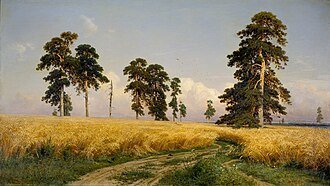
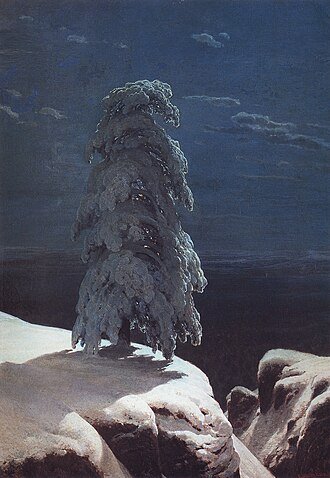
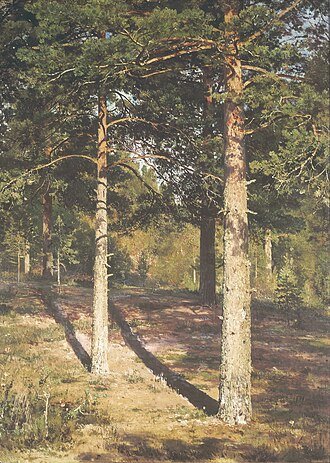
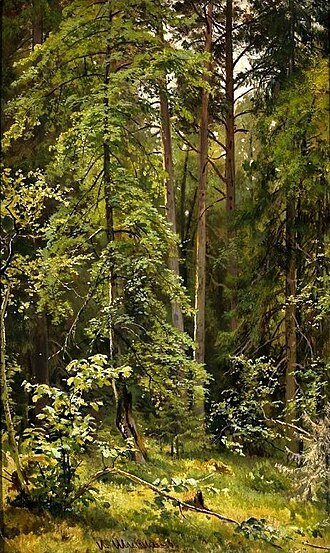
Shishkin's method rested on analytical studies of nature, made outdoors and attentive to the structure of trees, ground and light. He became famous for his forest landscapes, which conveyed the wild beauty of Russia's woodlands, and his paintings follow the seasons: snow, thaw, bright summer and the glow of evenings over pine stands. He was also an outstanding draughtsman and printmaker, and his etchings secured his reputation as one of the country's finest masters of the medium. Among his best-known canvases are Morning in a Pine Forest (1889), Rain in an Oak Forest (1891) and In the Wild North (1891), alongside Birch Forest (1871), Pine on Sand (1884) and Polesie Landscape (1884).
Vyra and the final years
He owned a dacha in the village of Vyra, south of Saint Petersburg, where he painted many of his finest landscapes. In 1873 the Academy formally gave him the title of professor after acquiring his painting Forest Wilderness. In 1892 he was invited to direct the landscape painting class at the Academy, a post he held only briefly for various reasons. He died suddenly on 20 March 1898 while seated at his easel, working on a new canvas. He was first buried in a Saint Petersburg cemetery, and in 1950 his remains and tombstone were moved to the Tikhvin Cemetery at the Necropolis of the Masters of Art.
Legacy
The most complete collections of his work are held today in the Russian Museum in Saint Petersburg and the Tretyakov Gallery in Moscow. Shishkin remains the most recognisable image of the Russian forest in nineteenth-century painting. He took from Realism a demand for close observation of nature, but turned it into a lyrical view of his country's landscape, an approach that shaped later generations of landscape painters and printmakers.
Works (182)


Painted in oil on cardboard in 1890, this small-format work shows a forest, a common subject within the landscape genre it belongs to. Its holding at the National Museum in Warsaw makes it accessible for close study, although the available information does not clarify who commissioned it or the circumstances of its making.
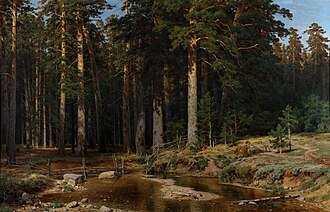
Landscape painted in 1898 in oil on canvas, on a large format. Its title suggests a grove of tall, straight trunks, probably pines, a subject that recurs in the work of its painter. It belongs to the landscape genre, where nature is the central subject. It is held at the State Russian Museum.
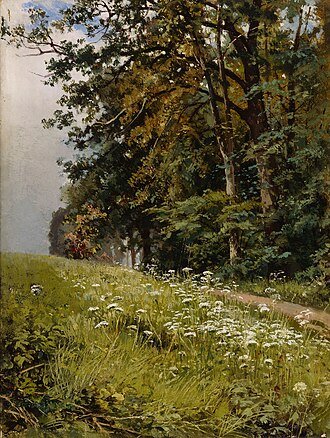
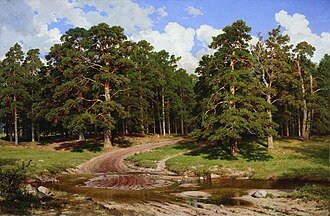
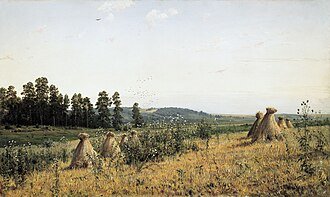
This painting by Ivan Shishkin depicts a landscape of Polesia, a marshy and wooded region of eastern Central Europe. Dated 1884, the oil on canvas has a horizontal format. Shishkin focused on the careful rendering of vegetation, tree trunks and the light filtering through the forest, traits typical of his landscape work.
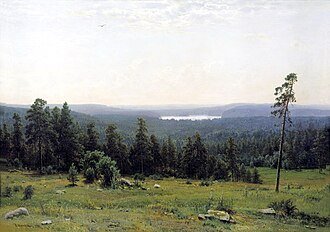
Oil on canvas by Ivan Shishkin, dated 1884 and held at the Tretyakov Gallery. The scene shows a pine forest receding toward a sky, with successive planes that draw the eye into the distance. Shishkin focuses here on the mass of trees and atmospheric depth, a recurring concern in his landscapes.
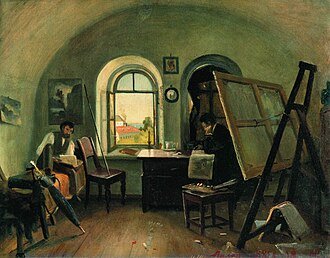
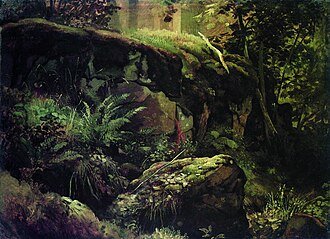
This oil on canvas by Ivan Shishkin, dated 1859, is titled Stones in the Forest. Valaam and takes the island of Valaam as its setting. It belongs to the landscape genre, in which the painter looked closely at nature. Today it is held by the Russian State Museum. Its modest size invites viewers to look up close.

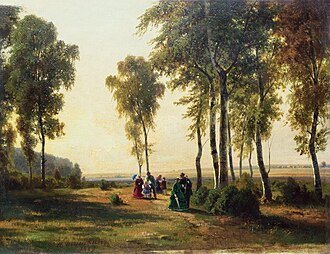
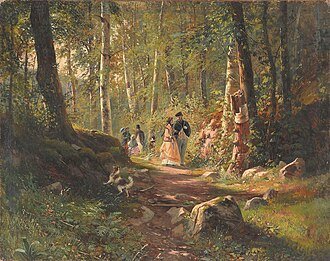
Landscape with Walking is an 1869 oil on canvas by Ivan Shishkin, a Russian painter. It is held at the Russian State Museum and belongs to the landscape genre. Its title points to a scene of people walking through a natural setting, though the available information does not clarify the composition, commission or possible symbolism of the work.
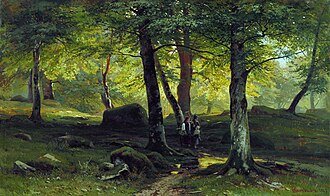

Landscape painting in oil on canvas, dated 1870, by Ivan Shishkin. Its title, For Mushrooms, points to foraging as the reason behind the scene, giving the landscape a human purpose. The work is held by the Russian State Museum. Looking slowly at the vegetation and light reveals the careful attention the painter gives to the natural surroundings.
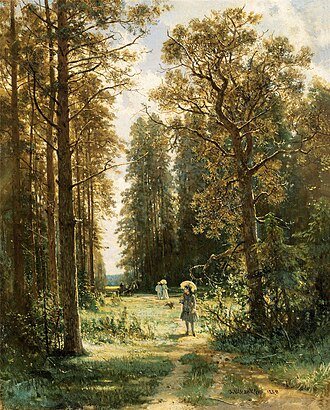
A landscape painting by Ivan Shishkin, dated 1880 and executed in oil on canvas. Its subject is simple: a path that winds between the trees and disappears into the thicket. That line leads the eye deeper into the forest, toward its far edge. The work is held by the Russian State Museum.

An 1879 oil landscape by Ivan Shishkin, titled as a study of the surroundings of Gurzuf. Its wording points to a preparatory sketch, likely made from direct observation of the site rather than as a finished composition. Painted on canvas-backed board, it shows the close attention to natural detail for which Shishkin's landscape work is known.
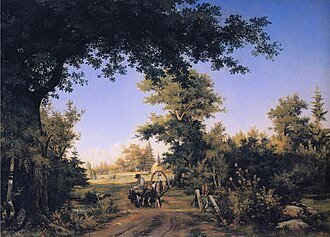
View on the Outskirts of St. Petersburg is an 1856 oil on canvas by Ivan Shishkin, belonging to the landscape genre. The picture presents an open outdoor setting on the edge of the city, a subject that lets the painter concentrate on how land, sky and light relate to one another. Beyond these basic facts, little is recorded about its commission or reception, so the image itself is the best guide.

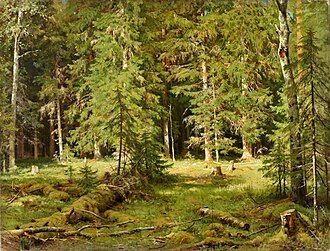
Oil on canvas dated 1880 by Ivan Shishkin, belonging to the landscape genre and centred on a forest. Little is documented about its commission or reception, so any reading rests on what the scene itself presents: the wooded subject as its main motif. It is held at the Yekaterinburg Museum of Fine Arts.
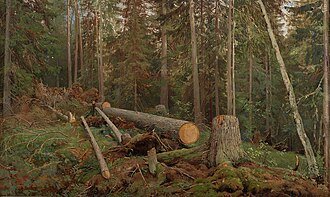

Painted by Ivan Shishkin in 1891, this oil on canvas is held by the Tretyakov Gallery. It shows a wooded area linked to Peterhof, named in the title alongside Countess Mordvinova. Shishkin was best known for forest landscapes, and here the focus falls on the dense trunks and the contrast between shadow and open patches of light.
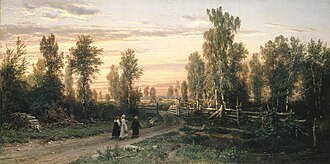
Evening is an 1871 oil on canvas by the Russian painter Ivan Shishkin, held at the Tretyakov Gallery. Its title points to the hour before nightfall, and the wide horizontal format invites the viewer to take in an expansive landscape. It belongs to the genre of landscape painting.
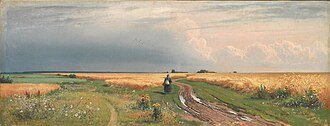
Landscape painted by Ivan Shishkin in 1866, in oil on canvas. Its elongated horizontal format, barely 27 by 71 centimetres, brings the viewer close to a strip of open country rather than a broad panoramic scene. The painting is held by the Tretyakov Gallery. Beyond these basic facts, little can be stated with confidence about its commission or context.
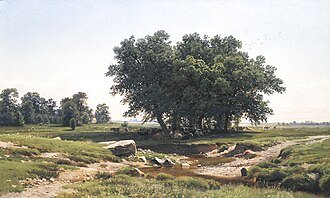
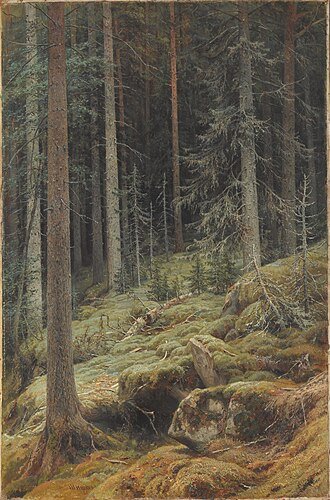
Oil on canvas from 1881 by the Russian painter Ivan Shishkin, belonging to the landscape genre. Its upright format, measuring 144 by 95 centimetres, probably points to a view of dense, untamed nature, as the title Wilds suggests. Without reference texts, details about its commission and reception remain unknown, so the work itself, held at the Tretyakov Gallery in Moscow, is the best guide to it.
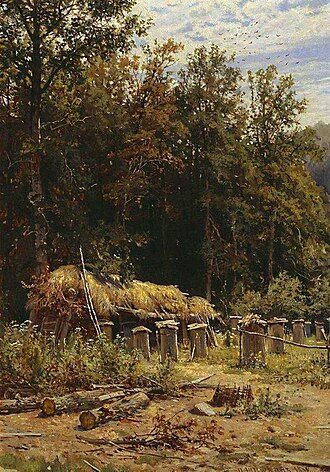
Oil on canvas by Ivan Shishkin, dated 1882, showing an apiary set within a forest landscape. Its subjects also point to farming and the timber trade, activities tied to wooded regions of Russia at the time. Shishkin is best known for his meticulous paintings of forests, where nature is rendered with great attention to detail.
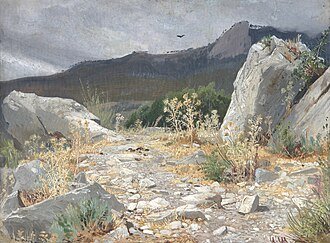

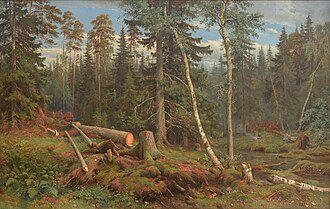

Painted in 1869 by Ivan Shishkin, this work offers a landscape view of the outskirts of Moscow, approached in the pastoral mode and focused on open countryside and vegetation. Its title points to the time of day, noon, though little else about its commission or reception is documented here. It is held in the Tretyakov Gallery.
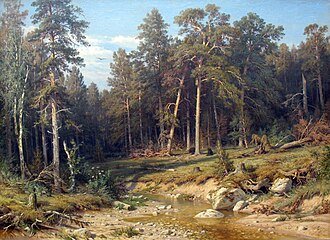
Painted by Ivan Shishkin in 1872, the canvas shows a pine forest of tall, straight trunks. The title refers to mast-timber, wood once prized for ships' masts, and to Viatka Province, today part of Kirov Oblast. Its subject is the forest rather than figures, a hallmark of landscape painting.

Landscape painting by Ivan Shishkin, dated 1892, executed in oil on canvas and held at the Tretyakov Gallery. Its title places the scene where the forest meets open ground, among flowers. Shishkin is best known for his forest landscapes, and this work belongs to that tradition. Without further reference material, details of its composition, commission or original context cannot be confirmed here.
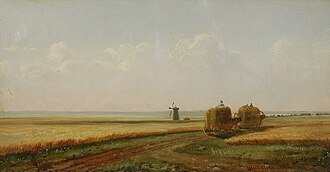
Landscape painting in oil on cardboard, dated 1861 and of modest size. A road winds through the valley and draws the eye toward the distance, so the path organizes the whole composition. With no further reference sources, it is best to read the scene from what is visible: the relationship between the road, the open ground and the light.
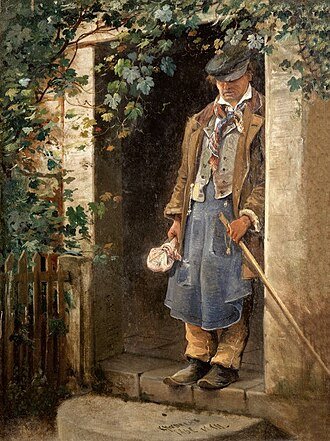
Painted in 1862 on cardboard, this genre scene by Ivan Shishkin is a small work, suited to close viewing. Its title points to a man on a doorstep, a motif that suggests an everyday moment, though no further details about the figure or setting are given.

Birch Grove is a landscape by Ivan Shishkin, dated 1871 and painted in oil on canvas. It shows a stand of birch trees, a motif common in Russian painting, whose pale trunks stand out against darker vegetation. Through careful treatment of foliage and light, the picture reflects the artist's attention to the natural scenery of his country. Beyond this, no further details can be confidently stated here.
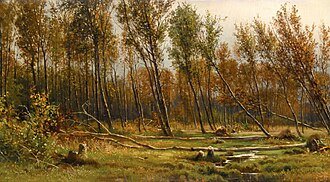
Oil on canvas dated 1871, this landscape has an elongated, horizontal format that suits a wide view of birch trees after a storm. Their pale trunks stand out as the main element of the scene. Little is recorded about its commission or early reception, so any reading should stay close to what the painting itself shows.
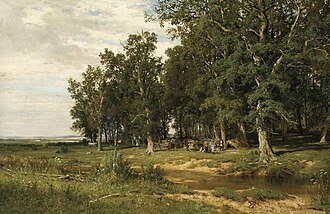
Landscape by Ivan Shishkin, dated 1874 and painted in oil on canvas. Its title names the scene: mowing in an oak grove, where farm work takes place among the trees. As a landscape, the painting focuses on nature and the setting rather than on individual figures. It is held at the Tatarstan State Museum of Fine Arts.
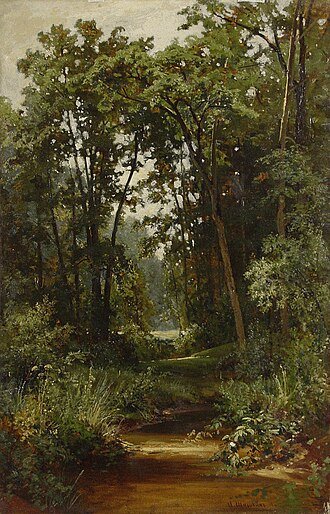
A landscape painting executed in oil on canvas in 1880, in a vertical format. Its title places the scene in a forest, but the available information says little about who commissioned it, the circumstances of its making, or how it was received. It is best approached as a view of nature that invites the viewer to linger over the trees and the light.

This small oil on cardboard, dated 1892, is the work of Ivan Shishkin, a Russian landscape painter known for his meticulously observed forests. It shows the early stirrings of spring in the woodland, with light filtering between the trunks and the foliage still fresh. Without further references, what stands out most is the care with which the artist renders the texture of the leaves and the forest floor.

Birch Grove is a landscape by Ivan Shishkin, dated 1884 and painted in oil on canvas. It shows a small stand of birch trees, whose pale trunks stand out against the dark vegetation behind them. Shishkin became one of the best-known Russian landscape painters of his era, admired for his close attention to foliage and to the light filtering through the leaves. Without further sources, it is best to limit the description to what the canvas shows.
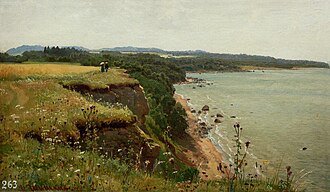
Oil study by Ivan Shishkin, dated 1888, showing the coast of the Gulf of Finland near Udrias, close to Narva. It was probably made as a preparatory sketch for a finished work, painted on canvas and cardboard. Its sketch-like character lets us see Shishkin's attention to the coastal landscape and to the light over the water.


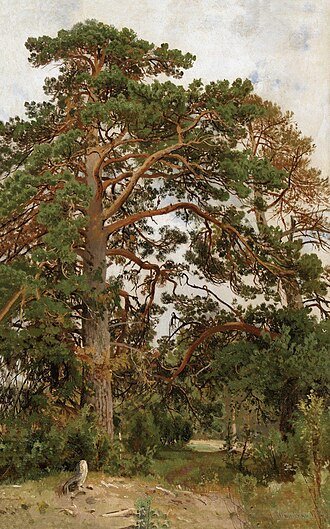
Landscape with Pine is an oil on canvas from 1890, attributed to the Russian painter Ivan Shishkin and held at the Tatarstan State Museum of Fine Arts. The available record offers little about its original context, but the title points to a scene built around a single tree, a subject Shishkin often treated with close attention to botanical detail and forest texture.
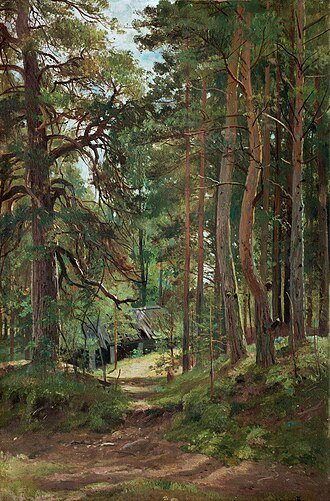
Landscape painting showing a forest, made by Ivan Shishkin in 1890 in oil on canvas and cardboard. Given its modest size, it was probably a small-scale work, though its commission and original purpose are not known with certainty. The painting is held at the Tatarstan State Museum of Fine Arts.
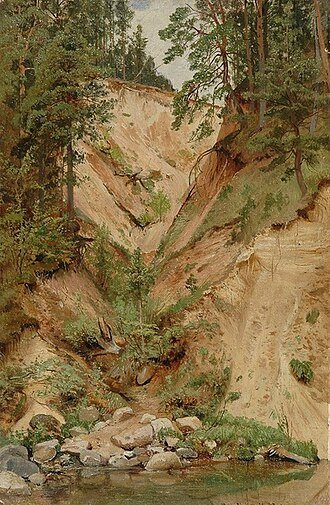
This 1893 oil on cardboard by Ivan Shishkin is known as Precipice. Going by its title, the subject seems to be a steep drop or sheer edge in the landscape, but the available information does not allow a detailed account of its composition or symbolism. The work is held by the Tatarstan State Museum of Fine Arts.
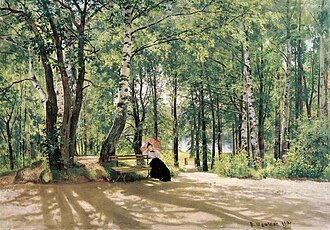
Oil on canvas from 1894 by the Russian landscape painter Ivan Shishkin. The title refers to the dacha, the country house that many Russian families used as a retreat outside the city. The available information does not specify the exact location or commission, so it is best read as a rural landscape.
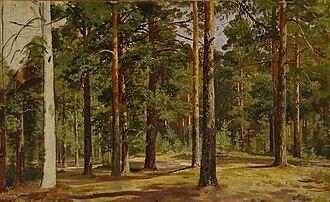
Unfinished sketch by Ivan Shishkin, dated 1894 and painted in oil on canvas. It shows a pine forest where the artist works mainly with patches of colour and with the trunks and light among the vegetation, while several areas are only roughly sketched. Its status as a study reveals how the image was built up, something finished works tend to conceal.
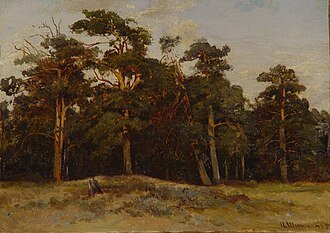
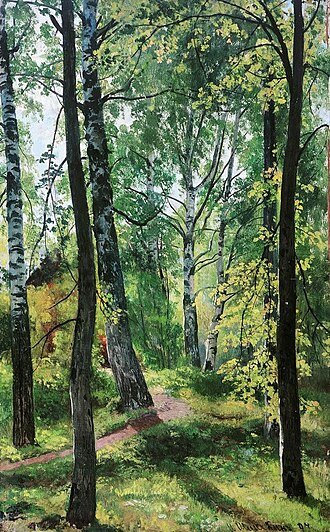
Oil study by Ivan Shishkin, dated 1897 and painted on canvas and cardboard. Its title refers to a forest of deciduous trees, a kind of woodland that changes with the seasons. As a study, it was probably a preparatory sketch or a direct observation exercise, though no further documentation confirms this. The painting is held at the Tatarstan State Museum of Fine Arts.
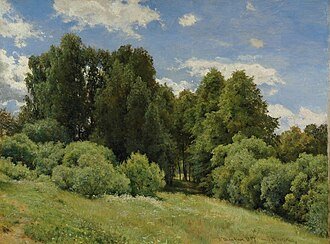
This forest landscape by Ivan Shishkin, dated 1897, shows a clearing where light filters between the trunks and the ground opens toward the distance. The composition places the viewer inside the scene, with a careful treatment of the undergrowth and foliage. The record offers no further details about its commission or reception, so it is best to stay with what the painting itself presents to the eye.
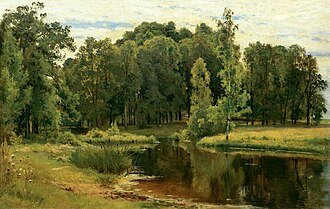
Oil on canvas from 1898 showing a small pond surrounded by trees in an old park. The scene feels calm and unhurried, with the water and the surrounding greenery forming the main focus. Rather than a dramatic landscape, it presents an everyday corner of nature that invites a quiet, lingering look.
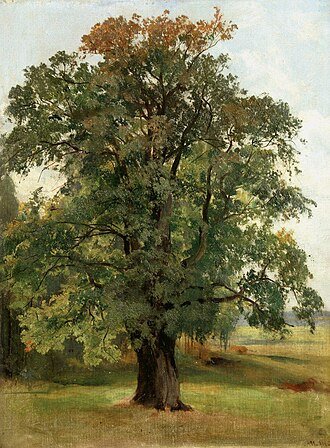
This 1900 oil on canvas by Ivan Shishkin is held in the Tatarstan State Museum of Fine Arts. Available information gives only its date, medium and museum, with no verified details about its subject, commission or composition. Without further documentation, any fuller account of the painting would be speculative, so this entry stays limited to these basic facts.

An oil study by Ivan Shishkin dated to around 1860, painted on canvas-board, a support often used for quick sketches. The scene is an open landscape with a cart, a motif that places a human presence in the countryside without making it the focus. Studies like this reveal direct observation from nature before a finished work.
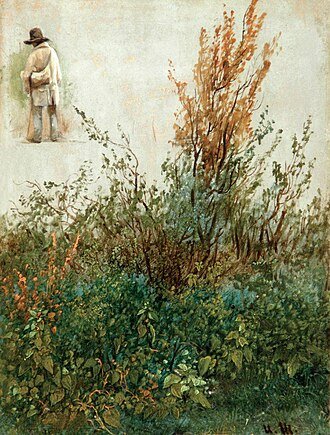
Small oil-on-panel painting by Ivan Shishkin, dated 1900, held at the Tatarstan State Museum of Fine Arts. The available information does not establish its subject, commission or reception, so any description of the scene would be speculative. Its modest size invites close viewing.
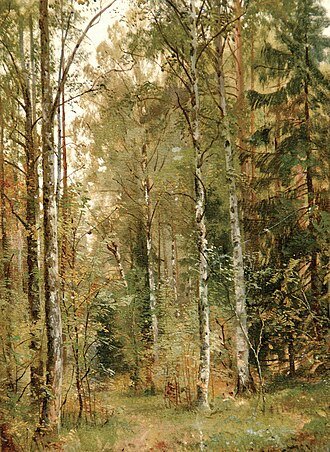
Small oil painting on canvas or cardboard, dated 1900 and attributed to Ivan Shishkin. The available data do not specify its subject or composition, so its content cannot be reliably described. Its modest size may suggest a study or sketch, though this remains uncertain from the available information.
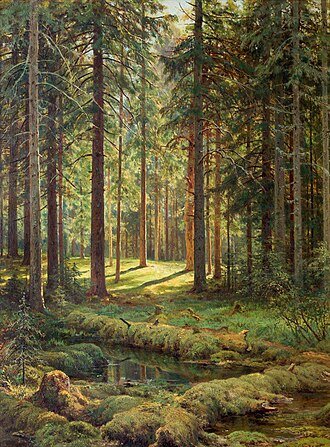
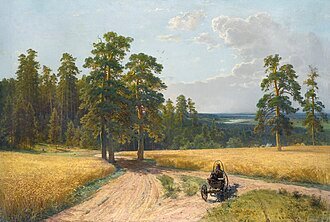
Painted in 1897 in oil on canvas, this work by Ivan Shishkin focuses on the boundary where a pine forest gives way to the open land around it. The available information says little about its commission or reception, so the composition itself, and the contrast between dense woodland and open space, is the best place to start looking.
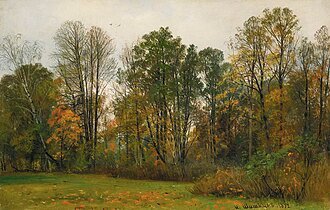
Oil on canvas dated 1892, in which Ivan Shishkin depicts a forest in autumn. A leafless tree and several shrubs with changing foliage stand in a grassy clearing, where a few birds are visible. The scene focuses on everyday nature and the shift from one season to the next, rendered through close attention to the vegetation.
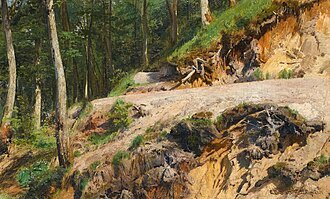
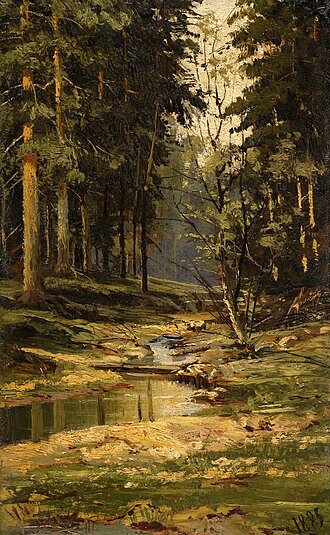
Landscape by Ivan Shishkin, painted in oil on panel in 1885. Its small format invites a close look, like an intimate view of a brook winding among trees. The title names the subject: a stream running through the forest. The available information does not establish the commission or the circumstances in which it was made.

Painted in 1896 by Ivan Shishkin, this work shows a mill set deep in a forest, as its title indicates. It is executed in oil on cardboard and belongs to the landscape genre. Details about its commission and history are not documented here, so the scene is best approached through what viewers observe, such as the relationship between the building and the surrounding trees.
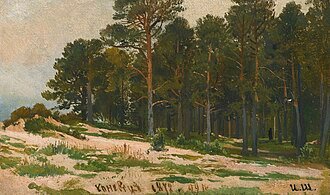
Painted in 1872 in oil on canvas and cardboard, this landscape centres on a stand of pines. The motif belongs to the landscape genre, and the available information does not establish a commission or the circumstances of its making, so any reading must rest on what the painting itself shows: the trees and their setting.


Oil on canvas dated 1897, with a forest of pines as its subject. Ivan Shishkin painted this wooded landscape, in which the trees themselves take centre stage. Without further details about its commission, reception or context, any reading should stay close to what the picture itself shows: a dense stand of pines as the main subject.
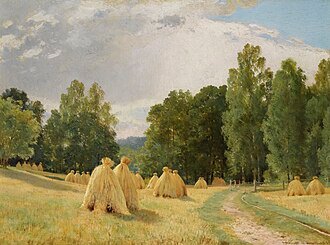
This landscape by Ivan Shishkin, dated 1890, shows a wide meadow dotted with several haystacks beneath an open sky. The available record allows only a description of the scene: a calm view over the countryside, with the composition arranged in planes that lead the eye toward the horizon. The title, Haystacks, refers to the stacks that dominate the foreground.

Landscape painting dated 1879, executed in oil on canvas in a tall vertical format. Its title points to a sandy coastline, and the elongated proportions give the composition a sense of height rather than breadth. Its commission, exact location and reception are not documented here, so any reading rests on title, technique and date.
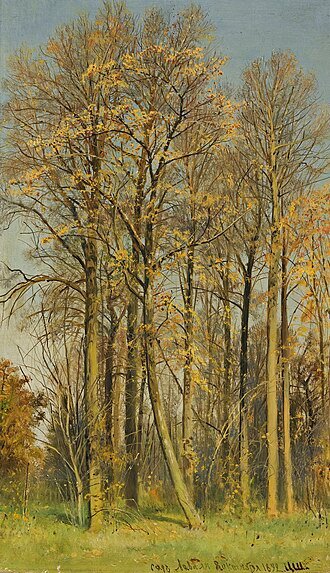
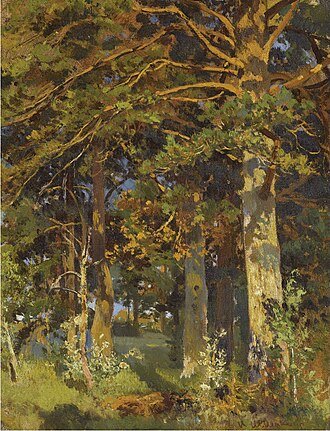
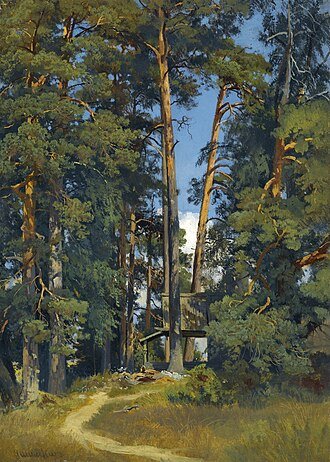
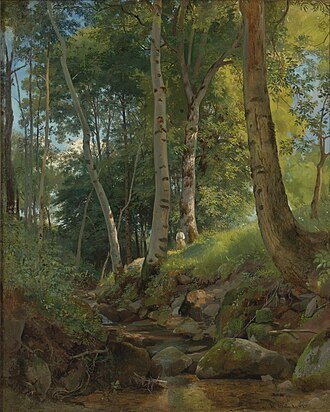
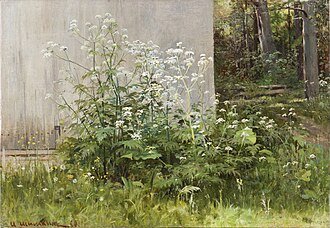
Oil on canvas dated 1880, in which Ivan Shishkin focuses on a modest motif: flowers growing along a fence. The title shifts attention toward this strip of nearby vegetation and the fence that bounds it, rather than toward a broad landscape. The work is held by the Vladimir-Suzdal Museum-Reserve.
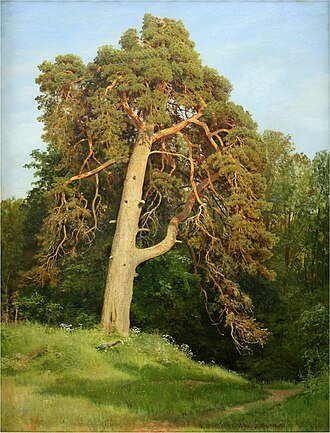
A landscape painting dated 1894, executed in oil on canvas by Ivan Shishkin. Its title, Pine. Merikul, points to a single tree and a place that the available information does not describe further. As a landscape, nature is the true subject, though reliable details about its commission or early reception are unknown. It is held at the Vladimir-Suzdal Museum-Reserve, where visitors can appreciate the painter's close attention to forests and to direct observation of the natural world.

Small-format oil on canvas landscape dated 1878. Its title refers to a clearing, an open space among trees that draws the eye into the forest. Available records say nothing about its commission or early reception, so any reading should stay close to what the painting shows.
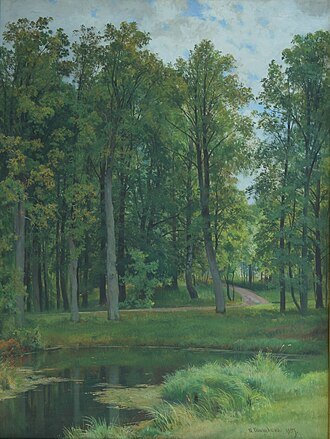
Painting by Ivan Shishkin dated 1897, a forest landscape in which a path winds between trunks and undergrowth until it disappears into the distance. The record offers no details about its commission or reception, so it is best to stick to what is visible: depth is built through the path and the light filtering through the thicket, and the careful rendering of vegetation is a familiar trait of the painter.
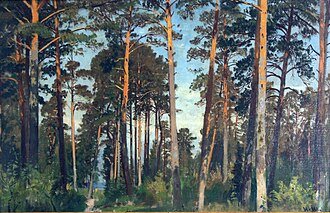
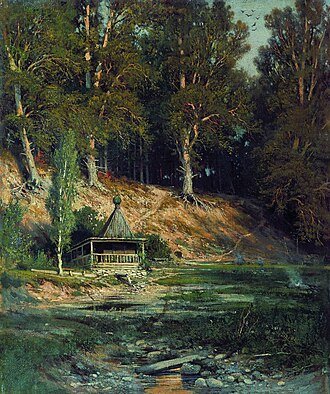
An oil-on-canvas landscape dated 1890, held by the Pskov Museum-Reserve. Details about the place depicted, any commission, and the circumstances of its making are not available, so its composition, symbolism and reception cannot be described with confidence. What is known is that it belongs to the landscape genre and was executed in oil on canvas, a common medium of the period.

Painted in 1883 in oil on canvas by Ivan Shishkin, this landscape follows a stream winding through a birch forest. The pale trunks stand out against the darker greenery behind them, and the curving water leads the eye deeper into the woods, with a calm, carefully observed atmosphere.
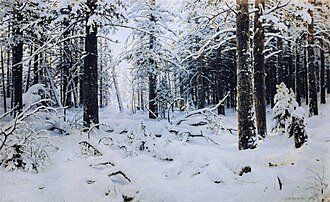
This large oil on canvas shows a winter landscape where snow covers both the ground and the trees. The cold light and muted tones suggest a silent, still atmosphere. The artist probably aimed to convey the calm of nature in that season, though his exact intentions are not known with certainty.
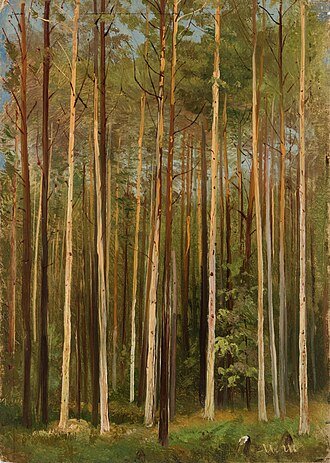
A forest study painted by Ivan Shishkin in 1900 in oil on paper. The small work focuses on Scots pines and the atmosphere of the woodland. Without further documentation, we can only describe what the record shows: a sketch from nature in which trees and light take centre stage.

This small oil painting shows a fragment of forest, with close attention to tree trunks, foliage and the light filtering between the trees. Dated 1900, it belongs to the landscape tradition Ivan Shishkin pursued, and its modest size suggests it was probably a study rather than a large-scale composition. Without further sources, it is best described cautiously.
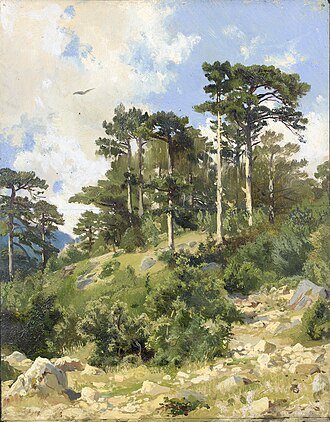
A small oil on paper mounted on board, in which Ivan Shishkin depicts ground covered with trees. Nothing is known about its commission or first owner. Given its modest size and loose handling, it probably served as a quick study, with brushstrokes that suggest the mass of the forest rather than its details.
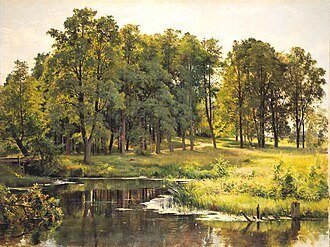
A landscape painted in 1897 by the Russian artist Ivan Shishkin, in oil on canvas. The title places the scene in a park, a subject that keeps nature at the centre of the composition. The work is held at the Tretyakov Gallery and belongs to the landscape genre, which Shishkin pursued throughout his career.
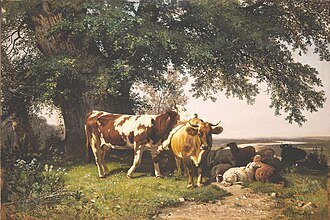
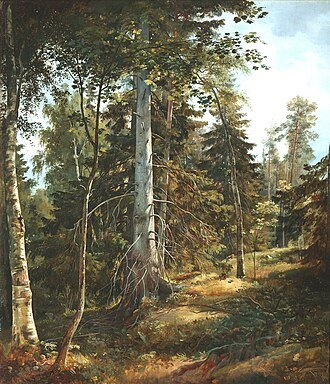
In 1867 Ivan Shishkin painted the inside of a dense forest, where trunks and undergrowth crowd together and block the view. Rather than a path or distant horizon, the scene focuses on tangled branches and shadows between the foliage, leaving the viewer enclosed among the trees.

Landscape painting in oil on canvas by Ivan Shishkin, dated 1895. The work belongs to the landscape genre and is held by a museum devoted to the art culture of Russia's north. Few details are available about its composition, commission or meaning, so this description is limited to its basic characteristics.
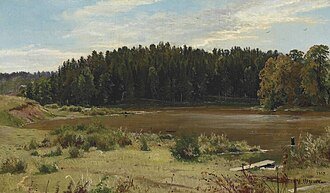
Painted in oil on canvas in 1882, this landscape by Ivan Shishkin shows a river running along the edge of a wood. The available record offers little beyond its title, so the description rests on what is visible: trees form a dark mass while the water opens a lighter path through the scene, organizing the composition in successive planes. Without further documentation, no commission or specific intention should be assumed.

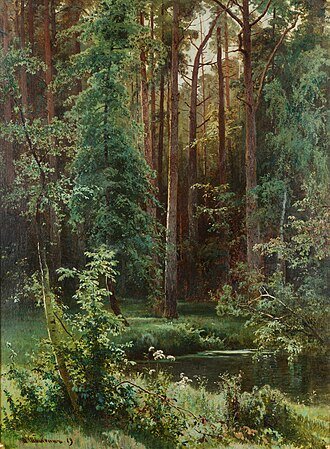
Painted in 1889 by Ivan Shishkin, this landscape depicts a woodland. Executed in oil on canvas, it has a slightly upright format, roughly 100 by 74 centimetres, which suits the rise of tree trunks and foliage. The work concentrates on the density of the forest and its shaded interior, inviting the viewer to wander into the thicket rather than focus on any single incident.

The painting shows a cemetery set deep in the woods, where gravestones sit among trunks and undergrowth. Ivan Shishkin, best known for his forest landscapes, makes nature the true subject of the scene. Painted in oil on canvas, it gives close attention to foliage and the play of light across the ground.
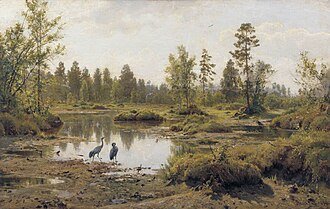
Oil on canvas by Ivan Shishkin, dated 1890, showing a marshland scene in Polesia. No information is available here about its commission or reception, so the reading rests on the scene itself. Its wide landscape format invites the eye to travel across a flat, wet terrain where nature fills the entire picture.

This work by Ivan Shishkin shows a forest clearing, with grass in the foreground and oaks and other trees rising around the open space. The composition centers on the light filtering through the foliage and on the detailed vegetation of the ground. As a landscape, the painting invites close looking at nature and at the precision with which leaves, trunks and earth are rendered. Dated 1896, it belongs to the period when the artist was deeply engaged with the Russian forest.

This landscape shows a dense, shadowy forest, where the eye gets lost among trunks and undergrowth. Shishkin worked in oil on canvas on a large scale, aiming to render nature with meticulous detail. Beyond its date of 1876, little is known about its commission or reception, so it is best to stick to what is visible on the surface.
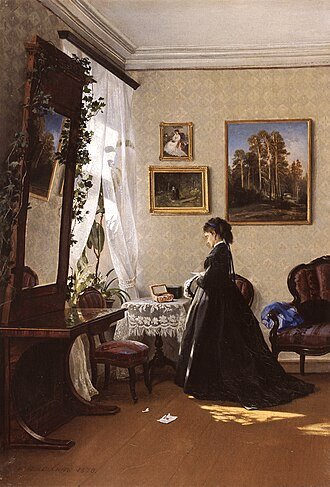
An oil on canvas dated 1870 and classified as a genre scene, this work by Iván Shishkin centres on an everyday moment before a mirror. Reliable information about its commission, its composition and the circumstances of its making is not available, so it is best read as an intimate glimpse of everyday life.
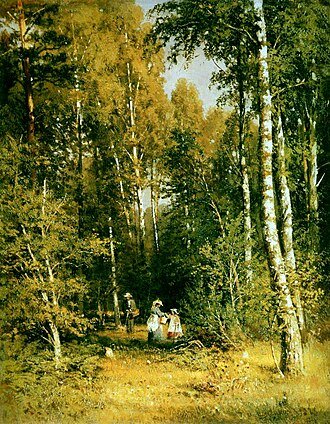
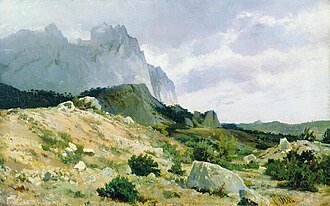
A small oil-on-cardboard painting from 1889 by Ivan Shishkin, the Russian landscape painter known for his precise depictions of forests and terrain. It shows a rocky landscape, viewed close to the stony ground. Records of its commission, context or reception are not available, so any reading of the work should stay with what the canvas itself shows.

Oil painting dated 1895 which, according to its title, depicts a dam, a structure that holds back the water of a stream. The available information does not record who commissioned it or where the scene is set, so any reading must rest on the title and the medium. Its small format does not allow us to go much further than this description.
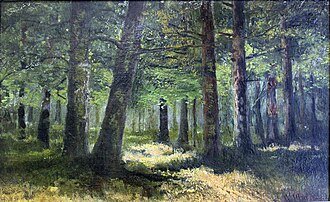
A landscape painting by Ivan Shishkin dated 1890, executed in oil on canvas. It shows a wooded scene on a small format, where the artist focuses on the mass of trees and the light filtering between them. The available record offers no further details about its commission or reception, so any reading should stay close to what the painting itself shows.

This landscape by Ivan Shishkin, dated 1888 and painted in oil on canvas, takes its subject from its title: trees toppled by the wind. Its wide horizontal format lets the eye wander deep into the woodland. The painting is held today by the Kiev National Picture Gallery.
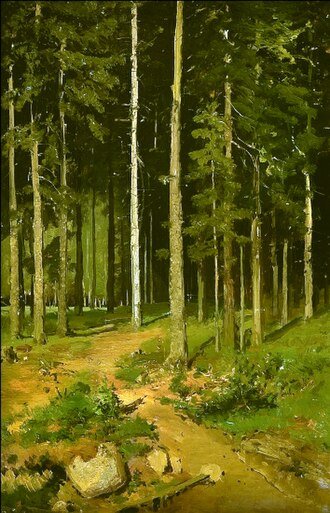
This 1900 painting by Ivan Shishkin shows a road winding among trees into a forest. The available information does not establish the commission or the circumstances of its creation. Its appeal lies in how the artist arranges the dense woodland and leads the eye along the path.
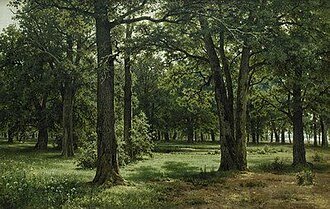
Landscape by Ivan Shishkin dated 1886, centred on a protected oak grove, as its title indicates, located near Sestroretsk and linked to Peter the Great. From the title, the scene is a grove of oaks, though no further details about its composition are known. It is held by the National Art Museum of Belarus.
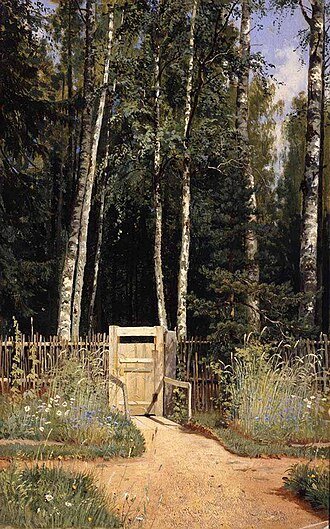
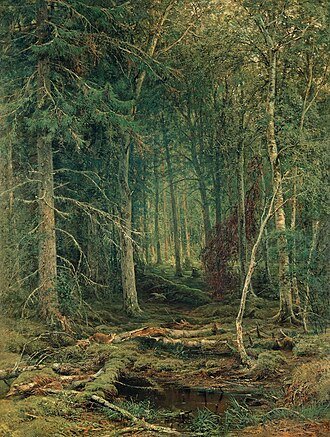
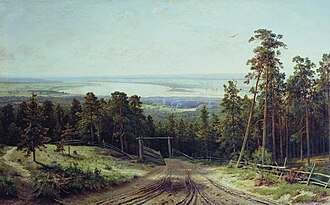
A large-format landscape in which Ivan Shishkin depicts the Kama river near Yelabuga. Painted in 1895 in oil on canvas, it is held at the Nizhny Novgorod State Art Museum. Beyond the subject itself, no further details about its commission or composition are available, so any reading remains limited to what is visible: a broad river and its natural surroundings.

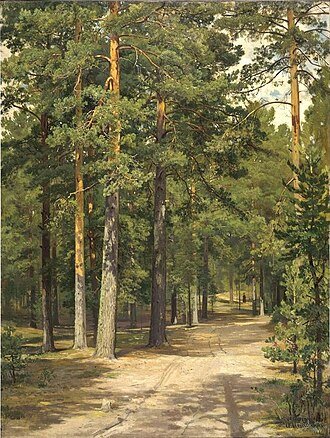
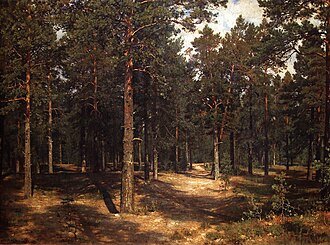
A dirt road disappears among tall pines with reddish trunks, lit by sunlight filtering through the canopy. Ivan Shishkin, a nineteenth-century Russian landscape painter, made this forest scene in 1885, with an almost botanical attention to the bark and the ground. The path draws the eye inward, revealing the artist's close interest in the real nature of his homeland.
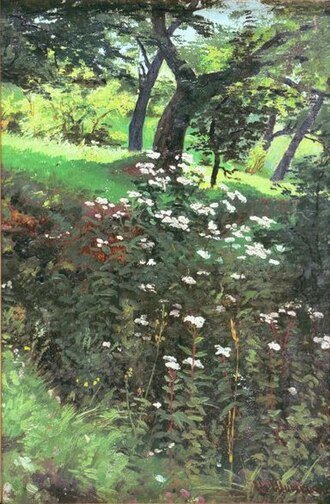
Landscape painting dated 1894 by Ivan Shishkin, executed in oil on canvas and of small format. The available information does not clarify its commission, the specific place depicted or the circumstances of its making. Its title, Wood Meadow, suggests a simple subject: the transition between woodland and open ground, a motif often associated with the artist's work.
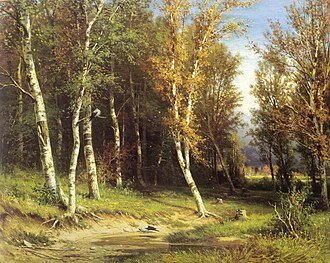
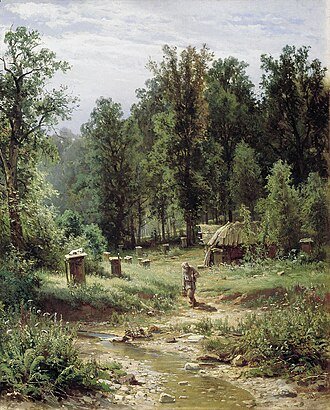


This 1891 oil on canvas by Ivan Shishkin takes an oak tree as its subject, as its title indicates. The painting's interest lies in its close observation of the tree and the landscape surrounding it. It is held in the Russian State Museum.
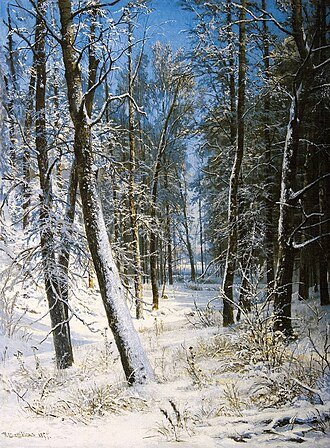
Painted in 1877 by Ivan Shishkin, this landscape shows a winter forest where frost covers the branches and the ground. The English title, with 'Frost' in brackets, points to the central subject: the effect of cold on the trees. Oil on canvas, it offers a quiet, sober view of the Russian woodland.
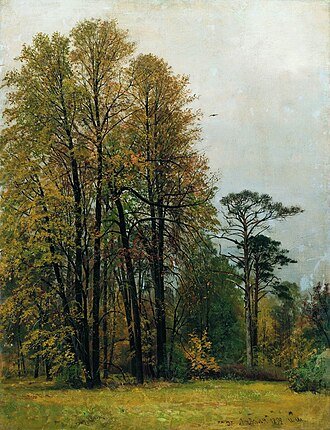
Autumn is an oil-on-canvas landscape painted in 1892 by Ivan Shishkin, a name closely associated with Russian landscape painting. Its title points to the season depicted, and the genre places nature at the heart of the work. It is held in the Russian Museum, where it can be seen today.
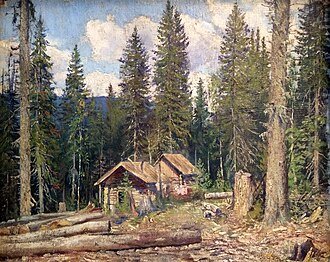
Landscape painting by Ivan Shishkin dated 1900, made in oil on canvas and cardboard. It shows a small hut set among trees, with the forest surrounding and framing the building. The work belongs to the landscape genre and is held by the Tchaikovsky Art Gallery. Its commission and original circumstances are not documented in the available material, so the description stays with what is visible.
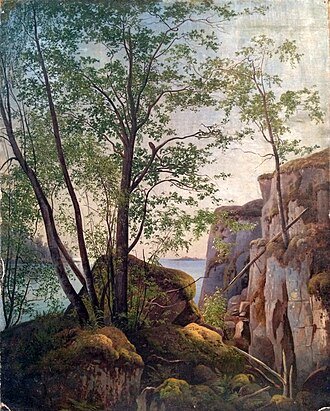
Landscape painted by Ivan Shishkin in 1900, depicting Valaam Island as its title indicates. It is executed in oil on canvas. The available information does not specify the commission, the viewpoint, or the meaning of the scene, so any reading of the painting should rest on what the image itself shows.
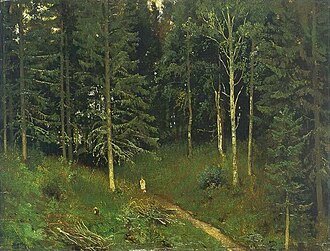
A forest landscape in which a path disappears among spruce trees and dark trunks, painted by Ivan Shishkin in 1880. Without reference texts to frame it, it can be described as a quiet scene where light barely reaches through the vegetation. The work belongs to the nineteenth-century Russian landscape tradition, focused on close observation of nature.
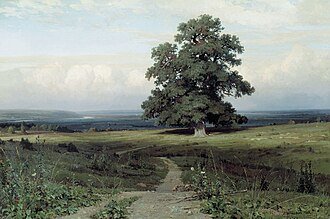
Large-format landscape painted in 1883 by Ivan Shishkin, in oil on canvas. The composition opens onto a broad valley that fills most of the picture surface and draws the eye across it. The available information does not clarify its commission or original reception, so the focus is best placed on the composition itself.
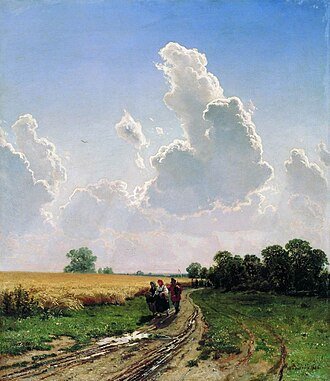
This 1866 painting by Ivan Shishkin shows the outskirts of Moscow, specifically Bratsevo, as its title indicates. It belongs to the pastoral landscape genre, where nature and rural life take centre stage. With no further documentation available, it is not possible to establish who commissioned it or the circumstances in which it was painted.
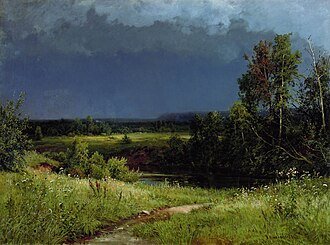
Painted in 1884 by Ivan Shishkin, this oil-on-canvas landscape takes its title, Before a Thunderstorm, as its main clue to the scene's mood: a moment of uneasy stillness before weather breaks. Beyond the title, little is known about its commission or early history. Today it belongs to the State Russian Museum.

This 1880 oil on canvas shows a stream winding down a wooded hillside. Its tall, large format gives the forest a commanding presence. The painting is held by the Kiev National Picture Gallery, and the available record says little more about its commission or early reception.

This 1900 oil on canvas shows a forest crossed by a stream, a motif common in the landscapes of Ivan Shishkin. Attention falls on the foliage and on the water winding between the tree trunks, both painted with care. Reliable information about its commission or reception is not available, so any reading rests on what the painting itself shows.

An oil on canvas from 1890 belonging to the landscape genre, showing a seashore as its title suggests. Beyond the date and the medium, little is documented about its commission or early reception, so the painting is best read through what it shows: the meeting of land and water and the quiet mood a shoreline can convey. It is held at the Kaluga Museum of Fine Arts.
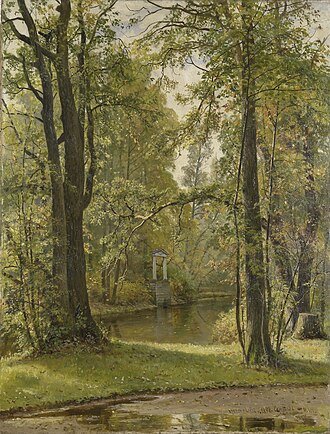
This landscape, dated 1892 and attributed to Ivan Shishkin, depicts an autumnal scene on Krestovsky Island, as its title indicates. Without further sources, it is not possible to say with certainty who commissioned it, which technique was used, or the circumstances of its creation. The painting is best approached through its subject: the light and colours of the season in one specific place.

This landscape by Ivan Shishkin, oil on canvas dated 1889, shows a stretch of shoreline off the Gulf of Finland, around Udrias near Narva. Its wide, horizontal format stretches the view across the water and invites the eye to travel along the coast. It is held today by the Russian State Museum.
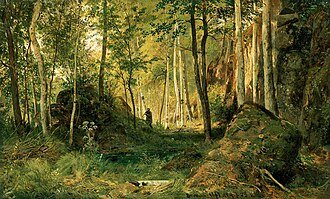
Oil on canvas dated 1867 by Iván Shishkin, in which landscape takes the leading role and a hunter appears as a human presence within the natural setting. The title points to Valaam Island, which probably serves as the setting for the scene. The picture reflects the painter's attention to the relationship between people and nature.


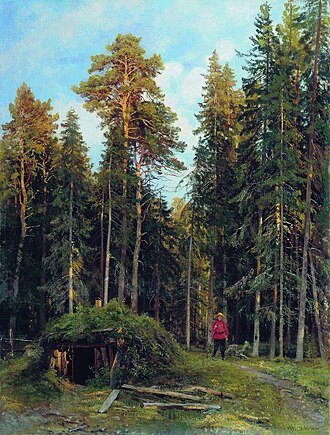

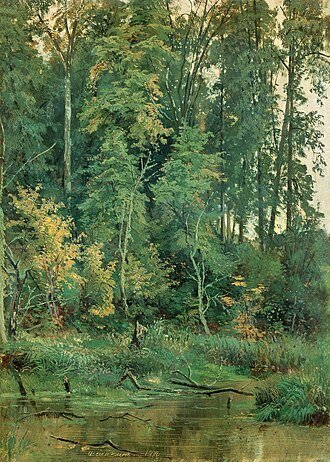
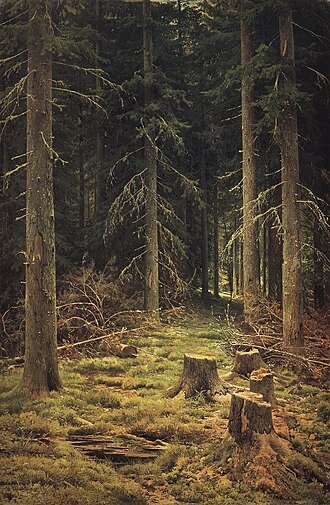
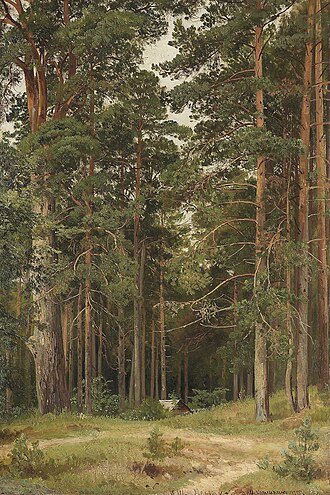
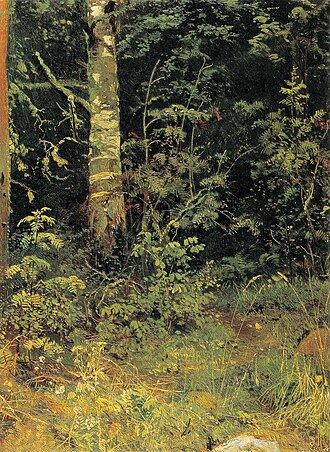
This small oil on canvas, dated 1878, shows birch and rowan trees, the two species named in its title. Its modest size suggests a close, intimate study of the vegetation rather than a broad panoramic view. The painting is held by the Tretiakov Gallery, where visitors can see it today.


Landscape with Forest is an oil on canvas from 1878 attributed to Ivan Shishkin, a Russian painter associated with forest scenery. The record places the work within landscape painting and identifies its home as the Perm Art Museum. With the available information, details about its commission or reception cannot be established.

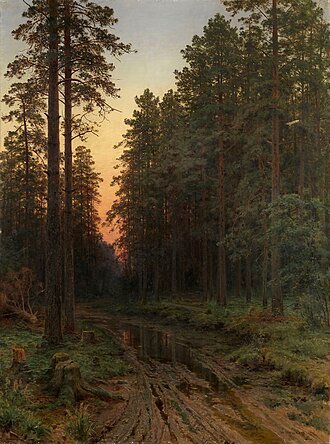
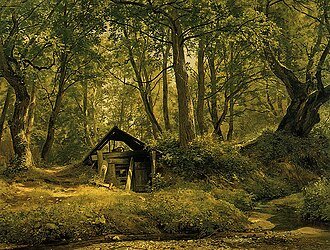

This oil painting on canvas and cardboard shows a sawn oak in a forest setting, with the cut trunk as its main subject. Dated 1890 and held by the National Museum in Warsaw, it probably focuses on the wood's texture and the woodland around it, though without further documentation its exact purpose remains uncertain.
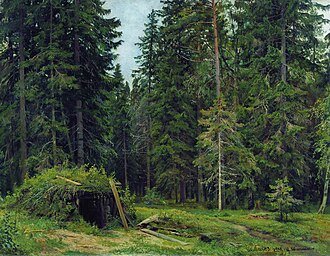
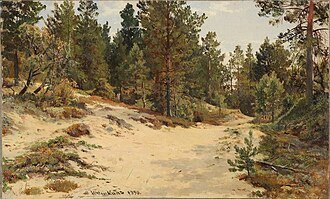
Landscape with Pines is an oil on canvas dated 1890 and attributed to Ivan Shishkin. Its classification places it within landscape painting, so nature itself, rather than figures or events, carries the subject. The available record does not document its commission, its early owners or its reception, so any reading of its composition or mood should remain tentative until further study.

Landscape painting by Ivan Shishkin, completed in 1892 in oil on canvas. Its title, Belovezh, points to a specific place, and the genre places it within Shishkin's work, which centred on nature as its main subject. Without reference documentation about its commission or reception, further details about its context and composition cannot be confirmed here.
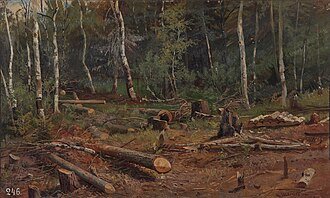
Painted in 1900 in oil on canvas and cardboard, this landscape takes its English title, Fresh logging, from a forest where trees have only just been felled. The scene dwells on the visible trace left by timber work in the natural surroundings. The painting is held by the Perm Art Museum.

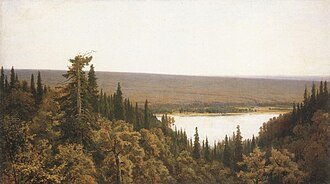
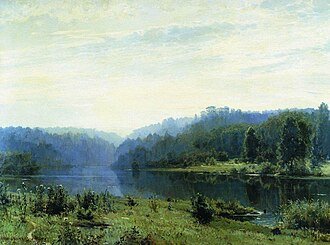
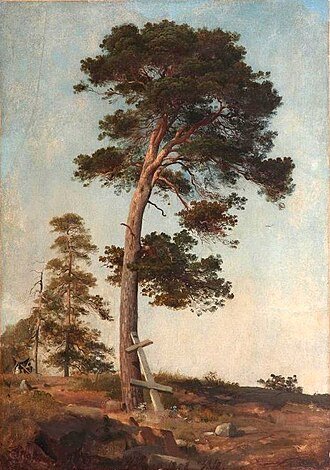
An oil study on cardboard dated 1858, in which Ivan Shishkin focuses on a single pine tree on Valaam island, in Lake Ladoga. The record offers no further information about its commission or destination. It belongs to landscape painting and shows the artist's attention to the detail of vegetation and the structure of the tree.

A landscape painting of oaks standing in sunlight within a forest. Dated 1900 and made in oil on canvas and cardboard, it seems to focus on the contrast between bright patches of light and the shade beneath the foliage, rendered with careful attention to the leafy masses of the trees. The work is held by the Ugra State Art Museum.

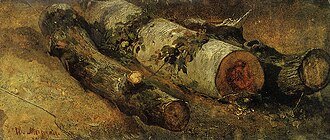
Painted by Ivan Shishkin in 1864, this small study in oil on paper mounted on cardboard shows a forest floor strewn with felled birch trunks. Its modest size suggests a sketch taken from nature rather than a finished composition, though its purpose is not documented here. Today it belongs to the State Russian Museum.


This small oil on canvas shows a group of town roofs covered in winter snow. Ivan Shishkin painted it in 1860, and it is now held by the State Russian Museum. Its modest size invites a close look at the rooftops, their shapes, and the quiet appearance of the town in that season.
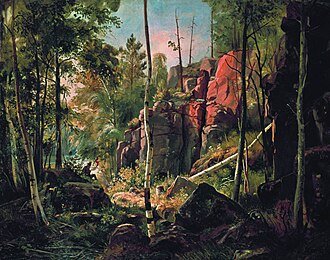
Landscape painting by Ivan Shishkin, dated 1859 and executed in oil on canvas. The title names Valaam Island, while the word "Kukko" that follows it is not explained in the record, so no specific meaning should be assumed. The work belongs to the landscape genre and is held by the Russian State Museum.

An oil study on paper mounted on board, dated 1868, in which Ivan Shishkin focuses on a group of logs near the village of Konstantinovka, close to Krasnoye Selo. Rather than a finished composition, it appears to be a study, where the painter looks closely at the texture of the wood and the light falling across the ground.

Painted in 1878, this small oil study by Ivan Shishkin focuses on fly agarics, fungi recognizable by their red caps dotted with white spots. Given its title and modest scale, it seems to be a direct observation rather than a finished composition, although its purpose is not specified.
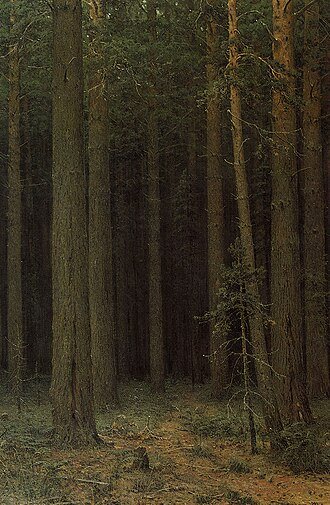
This 1881 oil on canvas shows a pine grove, and its title, Forest Reserve, suggests a protected woodland. The upright format emphasizes the height of the trunks and the depth between them. Lacking information on commission or reception, it is best approached mainly as a careful study of the vegetation.

Pine Forest is a landscape by Ivan Shishkin from 1889, painted in oil on canvas and cardboard and held by the Polenov Museum. Without further background, we can only describe a wooded scene centred on pines. Nothing confirms the location, the commission or the artist's intent behind it.
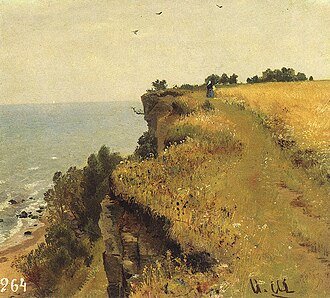
Oil study by Ivan Shishkin, dated 1888, showing a shore near Narva on the Gulf of Finland. It is painted on canvas and cardboard. Given its title, it is probably a preparatory sketch rather than a finished composition. A landscape work, it is held by the State Russian Museum.
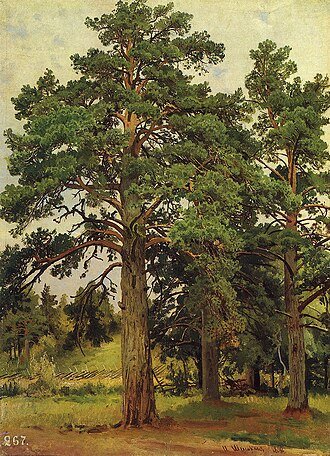
Oil-on-canvas study by Ivan Shishkin, dated 1890, focused on a pine bathed in sunlight. Given its title, which includes the name Meri-Hovi, and its status as a study, it probably served as a working sketch rather than a finished composition. Its interest lies in how light picks out the tree's forms against the landscape.
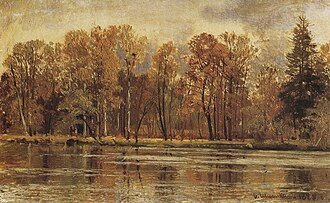
Golden Autumn is an oil-on-canvas landscape painted in 1888 by Ivan Shishkin and held by the Perm Art Museum. Its subject is nature itself rather than figures or narrative, and the title suggests the warm, golden light associated with the season. The available information does not clarify the commission or the specific place depicted.
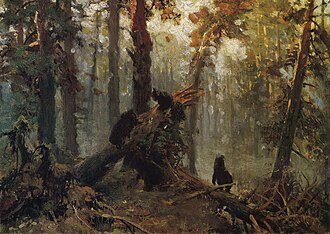
Oil on canvas sketch dated 1889, showing a pine forest in the early hours of the day. Shishkin focuses on the trunks, the branches and the light filtering through the vegetation. As a preliminary study, its handling is looser than in a finished work, and it is now held at the Tretyakov Gallery.
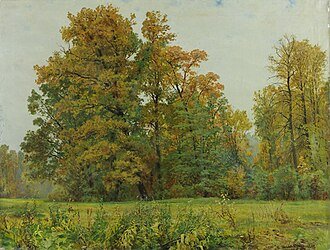
Landscape dated 1892 by Ivan Shishkin, placing the boundary between dense woodland and a more open space. The scene relies on detailed rendering of tree trunks, foliage and ground, with a meticulous handling of paint. The canvas is held today in the National Gallery of Armenia in Yerevan.
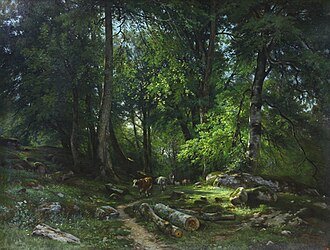
Landscape painting by Ivan Shishkin, dated 1864 and executed in oil on canvas. The scene shows a tree, a cow and a forest. The available information does not specify the commission or the meaning of the scene, so it is best to look at the work without assuming more than is known.
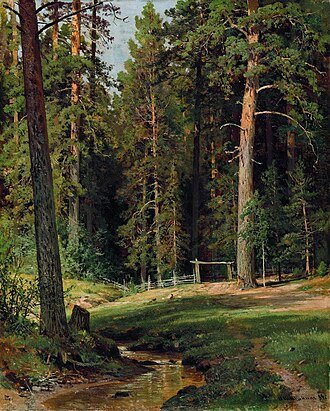
Landscape painted by Ivan Shishkin in 1884, in oil on canvas. The title points to a scene on the boundary between dense woodland and open ground. The available record says nothing about who commissioned it or how it was made, so the picture itself is the best guide: the contrast between shadowed trees and the light coming from beyond them.
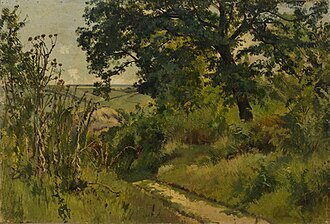
Oil on canvas dated 1900, this landscape study by Ivan Shishkin is held at the National Gallery of Armenia. The title points to an exploratory work rather than a finished painting, suggesting the artist may have used it to test light and composition. The record gives no details about the place depicted.
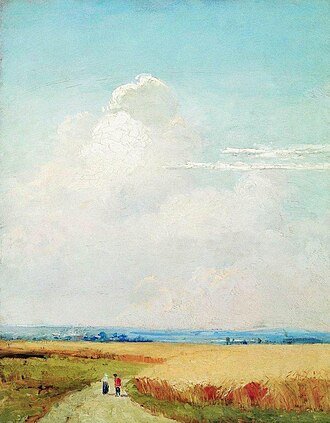
Oil on panel study by Ivan Shishkin, dated 1860, showing a landscape near Moscow at midday. Its small size and the word study in its title suggest a working sketch rather than a finished painting, a chance to record light and colour directly from nature. It belongs to the landscape genre.
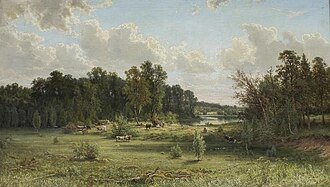
Painted in 1872, this large horizontal oil on canvas shows a small wood, a subject Ivan Shishkin returned to often across his career. Rather than a sweeping vista, the scene centres on a dense group of trees, where trunks, foliage and the open ground between them set the rhythm of the picture. The work is held by the Irkutsk Regional Art Museum.
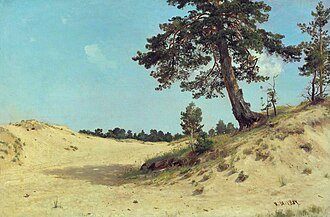
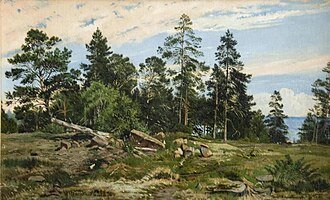
Landscape painting dated 1870 by Ivan Shishkin, with a forest standing beside the sea as its main subject. It is an oil on canvas in a wide, modest format of about 37 by 60 centimetres, now held at the Rybinsk Museum-Preserve. Without further information about its commission or reception, the safest way to read it is as a close study of nature, with the mass of trees set against the open expanse of water.

Oil on canvas from 1868, part of the landscape genre, showing a forest as the day fades. The available information says nothing about who commissioned it or how it was received, so any reading stays with what is visible: the dense mass of trees, the low evening light and the dark greens that suggest the hour of the day.
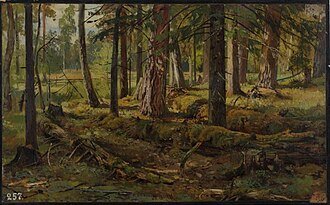
Forest study is an oil painting on cardboard dated 1900 and held at the Perm Art Museum. As its title suggests, it is a landscape study of a wooded scene, likely made from direct observation of nature. The modest support, cardboard rather than canvas, points to a working sketch rather than a finished piece meant for display.
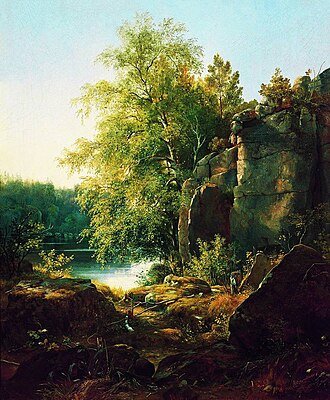
Oil on canvas from 1858 by Ivan Shishkin, showing a landscape view of Valaam island. This painting belongs to the landscape genre, and it cannot be stated with certainty who commissioned it or for whom it was made, so this reading focuses on its subject, medium and genre.

Landscape painting by Ivan Shishkin, dated 1870 and executed in oil on canvas. Its title, At the Monastery, suggests a scene set near a religious complex, though the available information does not specify the exact location or who commissioned it. The work belongs to Shishkin's output as a landscape painter and is held by the Kherson Art Museum.
Where to see the work
- Russian Museum Saint Petersburg · 31
- Tretyakov Gallery Moscow · 27
- Tatarstan State Museum of Fine Arts Kazan · 19
- Kiev National Picture Gallery Kyiv · 7
- Perm Art Museum Perm · 7
- Belarusian National Arts Museum Minsk · 6
- Yekaterinburg Museum of Fine Arts Yekaterinburg Municipality · 6
- National Gallery of Armenia Yerevan · 4
- Donetsk Regional Museum of Art Donetsk · 3
- Rybinsk Museum-Preserve Rybinsk · 3
- National Museum in Warsaw Warsaw · 2
- Bashkir State Art Museum (Nesterov Museum) Ufa · 2
- National Art Museum of Azerbaijan Baku · 2
- Nizhny Novgorod State Art Museum Nizhny Novgorod · 2
- Kovalenko Krasnodar Regional Art Museum Krasnodar · 2
- Pushkin Museum of Fine Arts Moscow · 2
- Art Museum of Estonia's Foreign Painting Collection · 2
- Tchaikovsky Art Gallery Chaykovsky · 2
- Finnish National Gallery Helsinki · 1
- Museum of Fine Arts, Budapest Budapest district XIV · 1
Teachers and pupils
Studied with
- Rudolf Koller 1828–1905
- Sokrat Vorobyov 1817–1888
Curiosities
Etching with aqua regia
While in Zurich, Shishkin made his first experiments in etching, using aqua regia to bite the plate. The technique became a lasting commitment: over his life he devoted almost as much time to etching as to painting, and his prints earned him a reputation of their own as a master of the medium in Russia.