Allegory of the Battle of Lepanto
Paolo Veronese, 1571
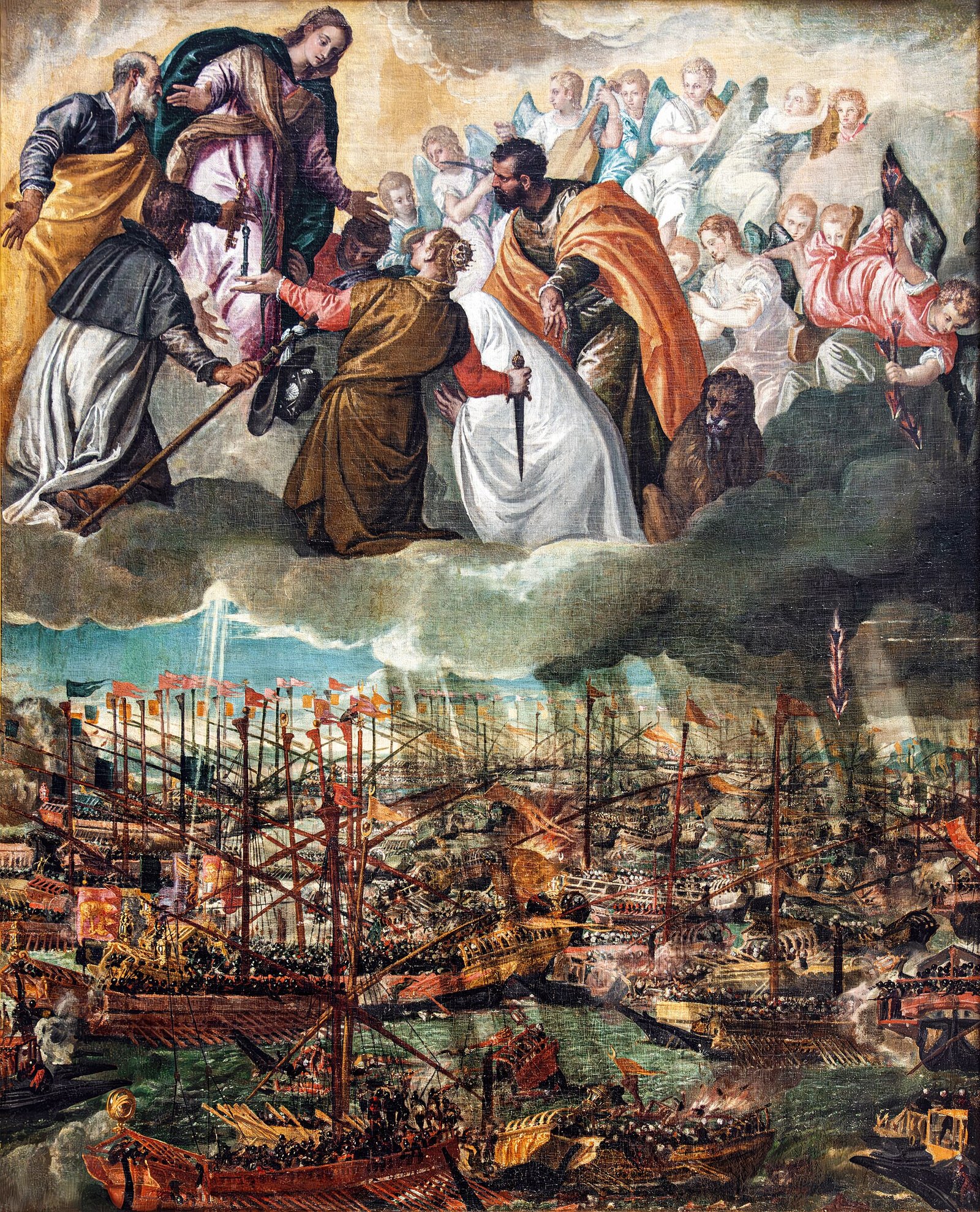
The painting, known in English as Allegory of the Battle of Lepanto, was painted by Paolo Veronese in 1571, the year the Holy League defeated the Ottoman fleet in the Gulf of Patras. It is an allegorical work: rather than depicting the combat itself, it presents the victory as an event raised to a religious sphere. At the centre, the Virgin Mary presides over the composition, surrounded by sacred figures and by personages who stand for the defenders of the faith and of the Republic. The saints who appear, such as Mark, Peter or Justina of Padua, link the victory to divine protection and to the city that celebrated it, Venice, whose winged lion symbolises the Republic.
The figures are arranged in planes of intense colour and warm tones, with a contrast between the solemnity of the upper part and the more earthly action at the margins. Veronese, a leading figure of Venetian Mannerism, works with a sweeping, theatrical sense of space that draws on the city's painting tradition while introducing the elegance of gesture typical of his time.
The Battle of Lepanto was one of the largest naval engagements in Western history: the last major battle fought almost entirely between galleys, and the largest since classical antiquity. Its significance went beyond the military sphere, since for many contemporaries it brought relief from Ottoman expansion and became a symbol of Christian unity in a Europe divided by religious wars. By turning the clash into an image with religious and political meaning, this painting reflects that significance and the wish to present the victory as a triumph of faith.
- Painter
- Paolo Veronese
- Date
- 1571
- Medium
- oil paint, canvas
- Dimensions
- 169 × 137 cm
- Museum
- Gallerie dell'Accademia, Venice
- Movement
- Mannerism
- Genre
- allegory
- Depicts
- lion, Saint Roch, Battle of Lepanto, Justina of Padua, Mark the Evangelist, Saint Peter, Mary, Republic of Venice
More works by Paolo Veronese