Allegory of Virtue and Vice
Paolo Veronese, 1565
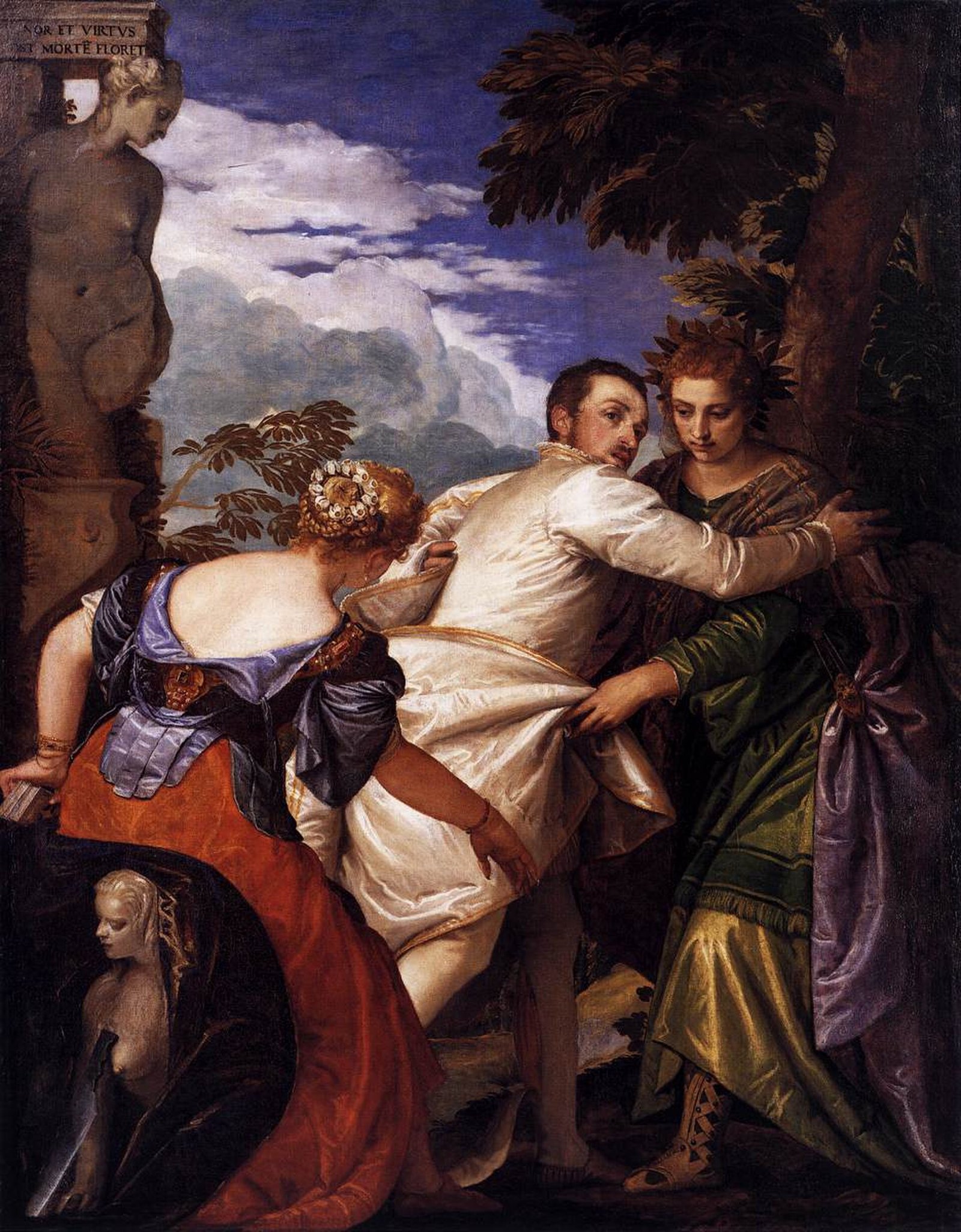
This allegory revisits the tale of Hercules at the crossroads, in which the hero must choose between the hard path of Virtue and the easier road of Vice. Veronese stages it as a tug of war: two women pull him in opposite directions. Hercules' body, at the centre, leans toward Virtue, who seems to be gaining the upper hand, while Vice holds on to him by force, as the torn stocking shows. Hidden beneath her skirt are a dagger and a sphinx statue, details that heighten the sense of danger and moral puzzle. Above the scene, an inscription carved in stone declares that honour and virtue flourish after death, a line that sums up the message: virtue overcomes vice, and its reward endures.
As an allegory, the painting departs from the historical and biblical narratives for which Veronese is best known, such as The Wedding at Cana. It also differs from the more informal allegorical treatments of Venetian painters like Giorgione and Titian. It is probably his first venture into this style and, together with Wisdom and Strength, also in the Frick Collection, it is thought to be among his first works to travel beyond the Alps.
The two canvases have travelled together since they were made, which for a long time led scholars to assume they were conceived as a pair. In 1970, Edgar Munhall suggested they were painted at the same time but were not pendants, a view that research at the Metropolitan Museum of Art in the 2000s supported. The painting passed through the hands of Rudolf II, Queen Christina of Sweden, the Odescalchi family and the celebrated collection of the Duke of Orléans, before reaching its present home. Its link to Rudolf II remains uncertain: it is not known for sure that he commissioned it, but it appears in his collection by 1621.
- Painter
- Paolo Veronese
- Date
- 1565
- Medium
- oil paint, canvas
- Dimensions
- 219 × 170 cm
- Museum
- The Frick Collection, New York City
- Movement
- Mannerism
- Genre
- allegory
- Depicts
- Heracles, vice, virtue
More works by Paolo Veronese