Venus and Mars
Paolo Veronese, 1570
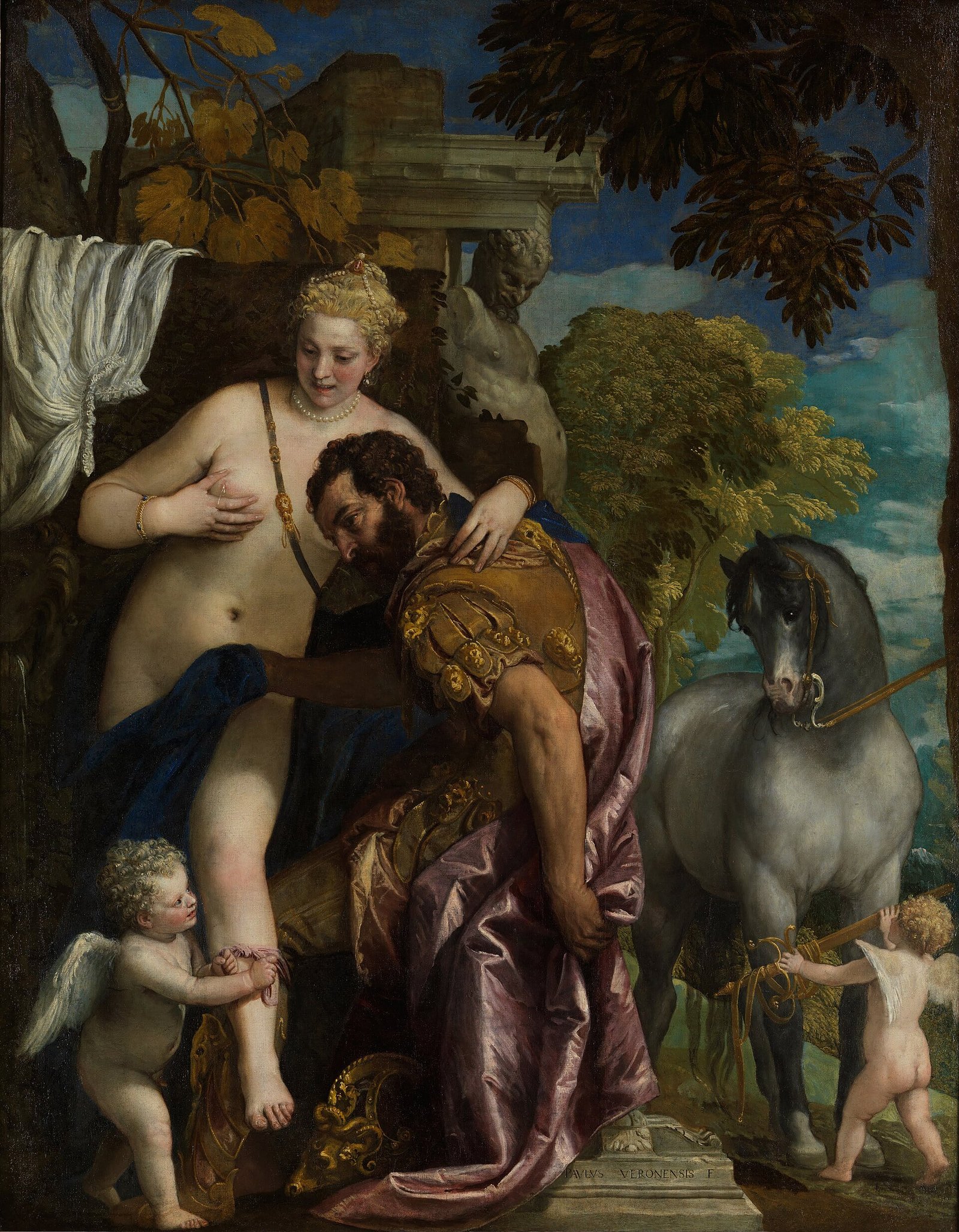
Venus and Mars is an oil painting on canvas that Paolo Veronese produced in the 1570s, during a period when he was working in Venice on mythological subjects alongside the religious commissions that formed much of his output. The picture shows the romantic encounter between Venus, goddess of love, and Mars, god of war, a story drawn from Ovid's Metamorphoses. The lovers meet in a calm, idyllic landscape far from any battlefield. Venus, nude, embraces the god with her left arm while he sits before her in armor. Her right hand rests on her breast, from which milk flows, a detail that stresses her femininity and that the painting connects with the abundance that peace brings.
The war horse on the right has a silhouette based on ancient sculpture. Its well-defined muscles convey strength, while the lowered head and quiet eyes soften the image. Two putti hold the key to the meaning. One tames the horse, standing for the mastery of Mars's warlike passions. The other ties a ribbon around Venus's legs, suggesting the bond of lovers in an enduring love and a time without war. Veronese signed the work on a stone disc with the inscription "PAVLUS VERONENSIS F".
X-ray examination, discussed by Alan Burroughs, showed that Veronese reworked the painting more than once. Venus's body was originally posed differently and was probably covered by a drapery falling downward. The innocent cherub was not part of the first version. Why the artist made these changes is not clear.
The commission came from Rudolf II, Holy Roman Emperor, and the work is one of three mythological and amorous paintings Veronese made for him; the other two are at the Frick Collection in New York. Its history is long. A catalogue of Rudolf's collection at Prague Castle was compiled in 1621, and the picture later passed to Ferdinand III of Habsburg. After the Swedish invasion of Prague in 1648 it entered the collection of Queen Christina of Sweden, who took it with her into Roman exile. It then moved through several European collections, including the Orléans Collection in Paris, and reached London before being acquired by the Metropolitan Museum of Art in 1910.
- Painter
- Paolo Veronese
- Date
- 1570
- Medium
- oil paint, canvas
- Dimensions
- 206 × 161 cm
- Museum
- Metropolitan Museum of Art, New York City
- Movement
- Venetian school
- Genre
- mythological painting
- Depicts
- nudity, ruins, garden, Mars, sitting, Eros, sword, chignon
More works by Paolo Veronese