The Family of Darius Before Alexander
Paolo Veronese, 1565
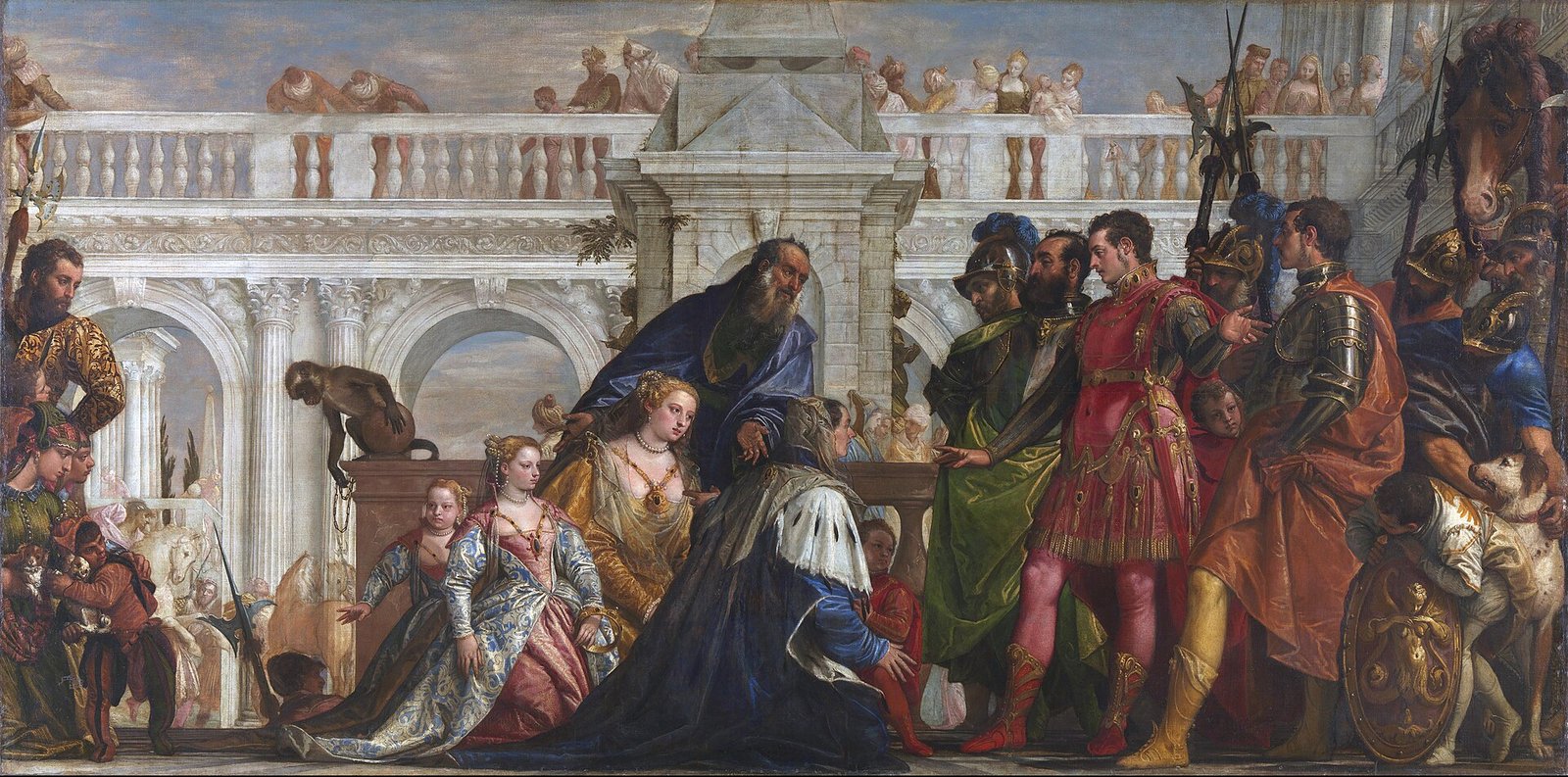
The Family of Darius Before Alexander is a large oil on canvas by Paolo Veronese, dated to around 1565 and held at the National Gallery in London since 1857. It shows an episode after the Battle of Issus in 333 BC, when Alexander the Great, having defeated Darius III, treated the Persian king's mother, wife and daughters with notable courtesy. Plutarch emphasises that Alexander kept their household and status intact and refrained from any intimacy with the captive queen.
The picture focuses on a misunderstanding that Plutarch does not record but several ancient writers do. According to Quintus Curtius, Alexander entered the women's tent accompanied only by Hephaestion, and Sisygambis, Darius's mother, knelt before the taller man, taking him for the king. When she realised her mistake, Alexander graciously declared that Hephaestion was Alexander too, sparing the old woman her embarrassment. Veronese keeps this ambiguity alive: the young man in red who gestures is usually identified as Alexander, although some historians reverse the two figures, and that unresolved doubt is often read as a sign of the painter's pictorial intelligence.
Veronese took liberties with the story. The scene unfolds in a palatial hall rather than a tent, and the rich costumes belong to the Venice he knew, not to ancient Greece or the East. Some figures may be portraits of contemporaries, a Venetian habit, though the proposed identities, including members of the Pisani family, remain debated. The composition is staged like a theatre: the principal figures occupy a shallow foreground, behind them pages, halberdiers, dwarfs, dogs and monkeys crowd the scene, and an arcaded architectural backdrop adds a processional rhythm. The curves of the distant arches echo the kneeling figures.
The painting belonged to the Pisani family, and Goethe is said to have admired it in Venice in 1786, though the story of its secret creation is probably legendary. Its purchase by the London museum was controversial, and Parliament debated the price. John Ruskin called it the most precious Veronese in the world.
- Painter
- Paolo Veronese
- Date
- 1565
- Medium
- oil paint, canvas
- Dimensions
- 236 × 475 cm
- Museum
- National Gallery, London
- Movement
- Mannerism
- Genre
- history painting
- Depicts
- Alexander the Great, family
More works by Paolo Veronese