Still Life with Onions
Paul Cézanne, 1898
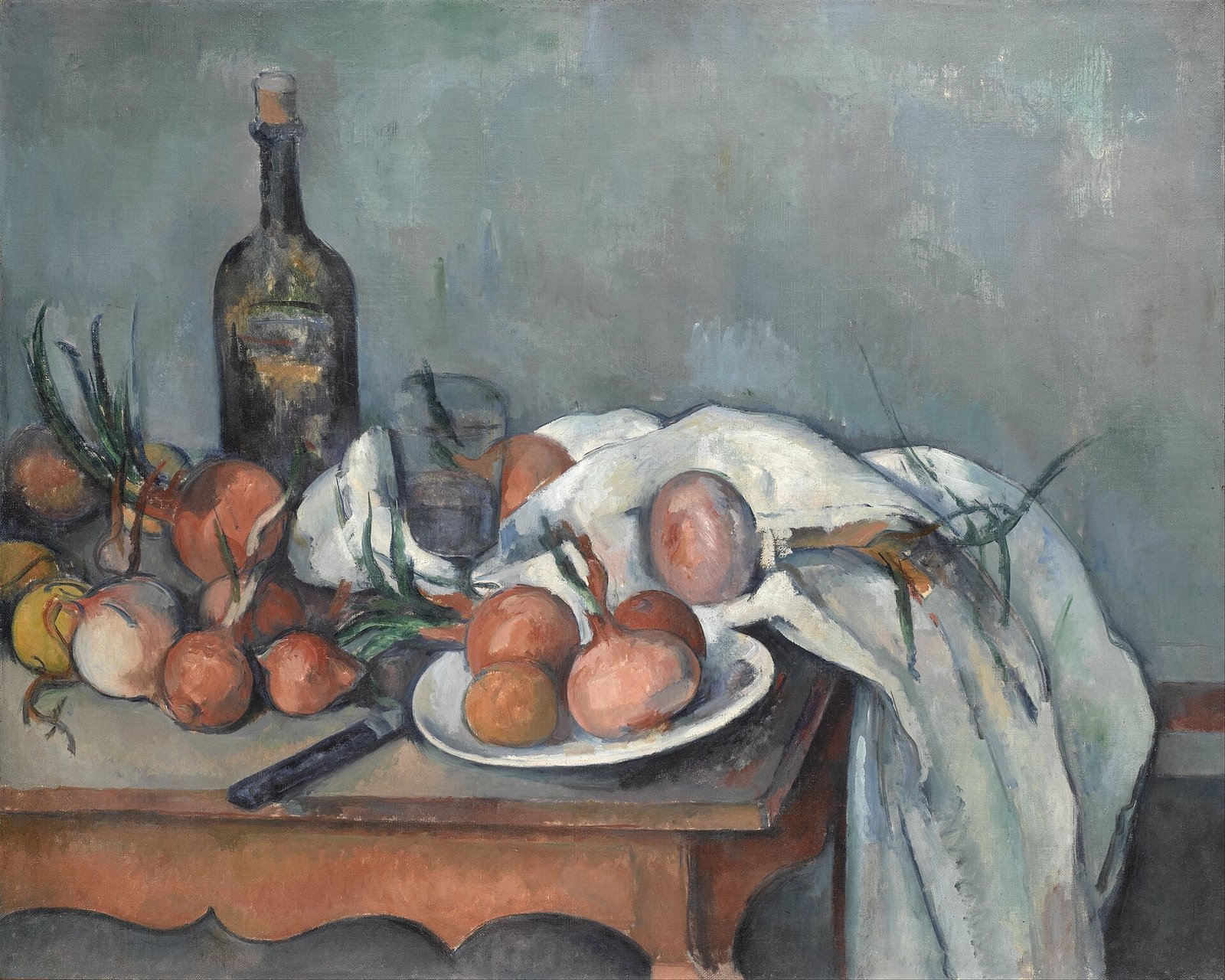
Still Life with Onions belongs to the group of still lifes that Paul Cézanne painted in the final years of the nineteenth century, when he had already developed a personal way of working. The catalogue date is 1898, though the work on this subject is usually dated from around 1895, a sign of the slow, deliberate pace with which the artist approached his still lifes. Among the genres he favoured were landscape, portraiture and still life, and within the last of these he returned most often to apples and fruit bowls. Here the focus falls instead on a cluster of onions, set beside a knife and a bottle, humble objects that Cézanne turns into a study of form.
What stands out most is the way he constructs space. He avoids a single, fixed linear perspective: the table seems to tilt towards the viewer, and each object is organised through planes of colour and brushstrokes that suggest volume rather than outline. Light is not dissolved in the manner of the Impressionists but distributed across contrasting areas that give the forms weight. This search for structure, for treating painting as an ordered construction, is one of the qualities that historians have identified as a precursor of modern art.
The work belongs to Cézanne's Post-Impressionist output, and his approach is often credited with a decisive influence on Cubism. It is now held at the Musée d'Orsay in Paris, where it can be seen as an example of how an everyday subject can become an inquiry into form, colour and perception.
- Painter
- Paul Cézanne
- Date
- 1898
- Medium
- oil paint, canvas
- Dimensions
- 660 × 820 cm
- Museum
- Musée d'Orsay, Paris
- Movement
- Post-impressionism
- Genre
- still life
- Depicts
- onion, knife, bottle
More works by Paul Cézanne