The Boy in the Red Vest
Paul Cézanne, 1889
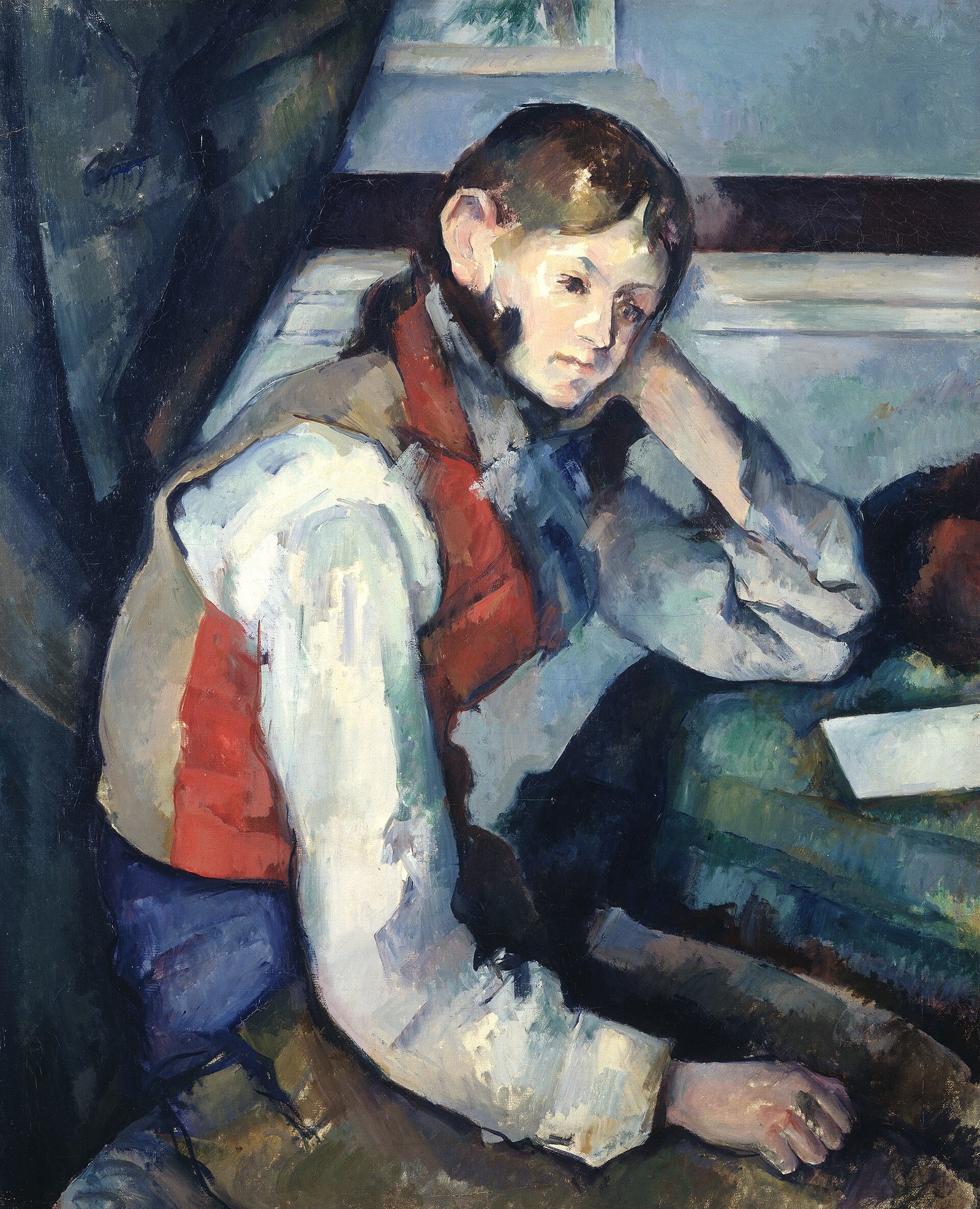
The Boy in the Red Vest is one of four portraits Paul Cézanne painted of a young Italian boy wearing this garment, made around 1888–1890 in different poses. The series gave him a way to study the relationship between the figure and the space around it, a concern that occupied much of his mature work. This version, the best known of the group, shows the boy seated, his elbow resting on a table and his head supported by his hand, in a pose that conveys a certain melancholy. The other three portraits are held in American museums.
The painting is notable for its rich, dense and festive colour, and for a composition built on three main diagonals: the tilt of the boy's back and head, the deep green curtain behind him, and the long line of the seat and table rising from the lower left. These are balanced by the diagonals of the thighs and arms, producing a tightly interlocking structure of crossing lines. Cézanne holds together compositional rigour and loose, spontaneous brushwork, a quality the Foundation E.G. Bührle, its current owner, has emphasised. In 1895 the critic Gustave Geffroy said it could stand comparison with the finest figure paintings of the Old Masters.
The picture passed through the hands of the dealer Ambroise Vollard and collectors Marcell Nemes and Gottlieb Reber before reaching the businessman and collector Emil Georg Bührle, who bought it in 1948. After his death, his heirs gave it to the foundation bearing his name. It was stolen from there in February 2008 and recovered in Serbia in April 2012.
- Painter
- Paul Cézanne
- Date
- 1889
- Medium
- oil paint, canvas
- Dimensions
- 80 × 64 cm
- Museum
- Kunsthaus Zürich, District 1
- Movement
- Impressionism
- Genre
- portrait
- Depicts
- boy
More works by Paul Cézanne


