The Hanged Man's House
Paul Cézanne, 1874
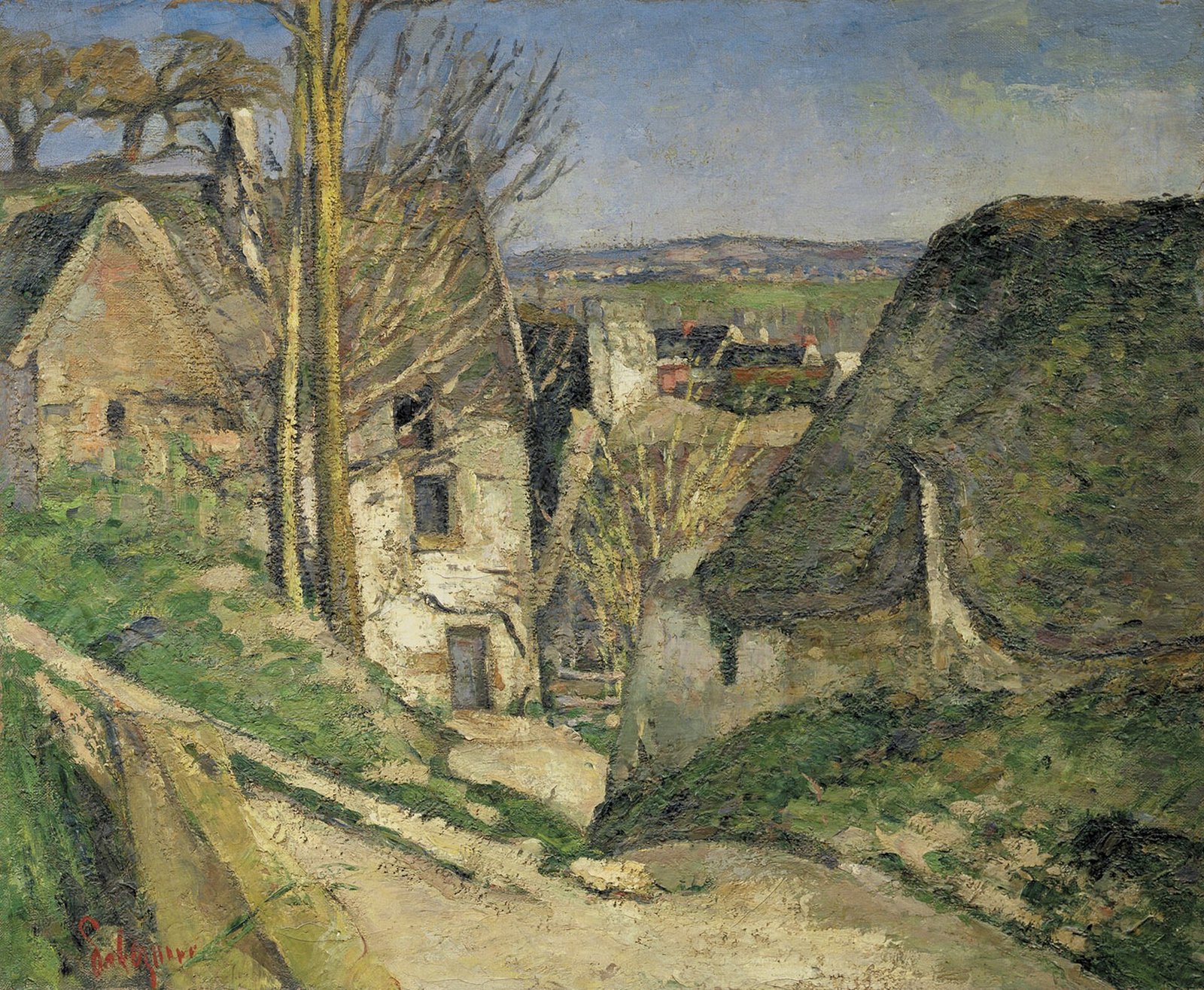
The Hanged Man's House, Auvers-sur-Oise is an oil on canvas that Paul Cézanne painted in 1874 in the village of Auvers-sur-Oise, about 27 kilometres north of Paris. The picture was shown at the First Impressionist Exhibition that same year, and it was the first work Cézanne managed to sell to a collector, a modest but meaningful milestone for an artist who had not yet gained public recognition. It is now held at the Musée d'Orsay.
The scene shows a corner of the village: a house, a path that splits in two, and tree branches reaching toward the top of the canvas. No people appear, and the cool, muted palette gives the scene a feeling of solitude and stillness. The title refers to a house associated with a hanged man, although nothing in the painting itself makes that story visible.
Formally, Cézanne drew on the approach of his friend Camille Pissarro, using short, grainy, broken brushstrokes and pale colours. Yet the composition moves beyond simply capturing a passing moment. Visual axes radiating from the centre, formed by the paths, the bench and the branches, organise the space in a deliberately intricate way. Cézanne also introduces deliberate imperfections of perspective, visible in the angle of the path on the left and the bank on the right, which bend traditional geometric logic.
These choices point toward Cézanne's later aim of treating landscape as a construction of volumes, planes and colour rather than a faithful record of nature. For this reason the painting is regarded as an important link between Impressionism and the art that followed.
- Painter
- Paul Cézanne
- Date
- 1874
- Medium
- oil paint, canvas
- Dimensions
- 56 × 66 cm
- Museum
- Musée d'Orsay, Paris
- Movement
- Impressionism
- Genre
- landscape painting
- Depicts
- landscape, thatched cottage, broad-leaved tree, Auvers-sur-Oise, house, village
More works by Paul Cézanne