Mardi Gras
Paul Cézanne, 1888
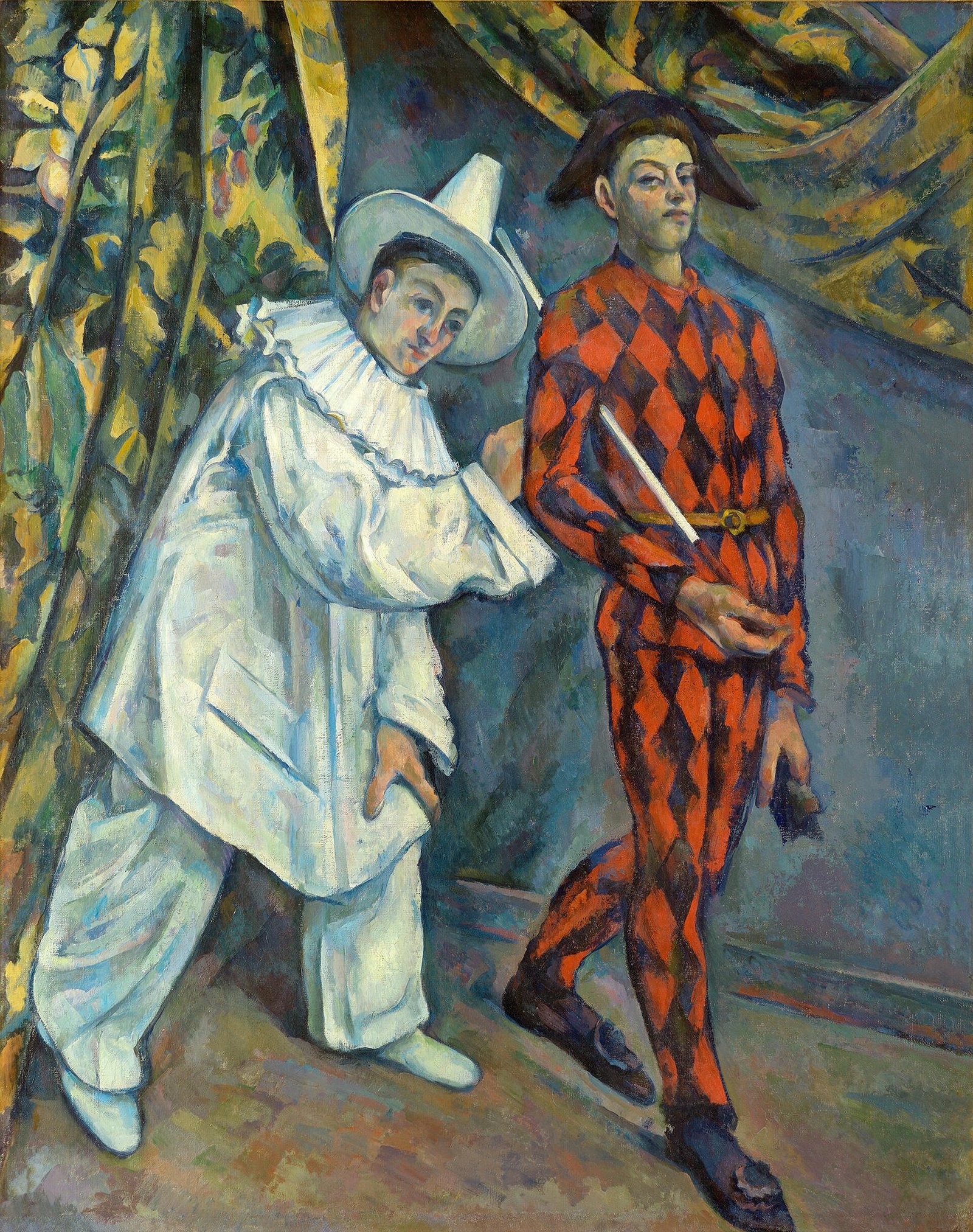
Mardi Gras is an oil on canvas by Paul Cézanne dated 1888, now held at the Pushkin Museum in Moscow. Its title points to carnival, and the scene centres on two figures familiar from the commedia dell'arte: Harlequin, in his multicoloured diamond costume, and Pierrot, dressed in white with a more wistful air. Both stand in the foreground before a dark backdrop framed by a curtain, a theatrical device that makes the setting feel like a stage. Cézanne worked from live models: his son Paul posed for the harlequin, and Louis Guillaume, a friend of the painter, for the other figure. This choice helps explain the slightly withdrawn mood of the pair, who seem absorbed in themselves rather than engaging the viewer.
What makes the picture notable is how it builds form. Cézanne reduces volumes to planes of restrained colour and lets the surfaces organise themselves through contrast rather than traditional modelling. This pursuit of a solid underlying structure, which he developed during these years, is often considered a starting point for modern painting. The work is also linked to Picasso's later fascination with the harlequin, a figure the young artist would return to, though in his hands the forms grew more angular and the hands far larger.
The painting's history is also telling. It passed through the collection of Victor Chocquet, then the dealer Paul Durand-Ruel, and finally Sergei Shchukin, who gathered it with the rest of his holdings. After the October Revolution the Soviet state took over that collection, and the work went to a museum of modern Western art in Moscow until that museum closed in 1948; it now belongs to the Pushkin Museum's collection.
- Painter
- Paul Cézanne
- Date
- 1888
- Medium
- oil paint, canvas
- Dimensions
- 102 × 81 cm
- Museum
- Pushkin Museum of Fine Arts, Moscow
- Genre
- genre art
- Depicts
- Harlequin, Pierrot, Mardi Gras, Carnival, curtain, disguise, man
More works by Paul Cézanne