Rideau, Cruchon et Compotier
Paul Cézanne, 1893
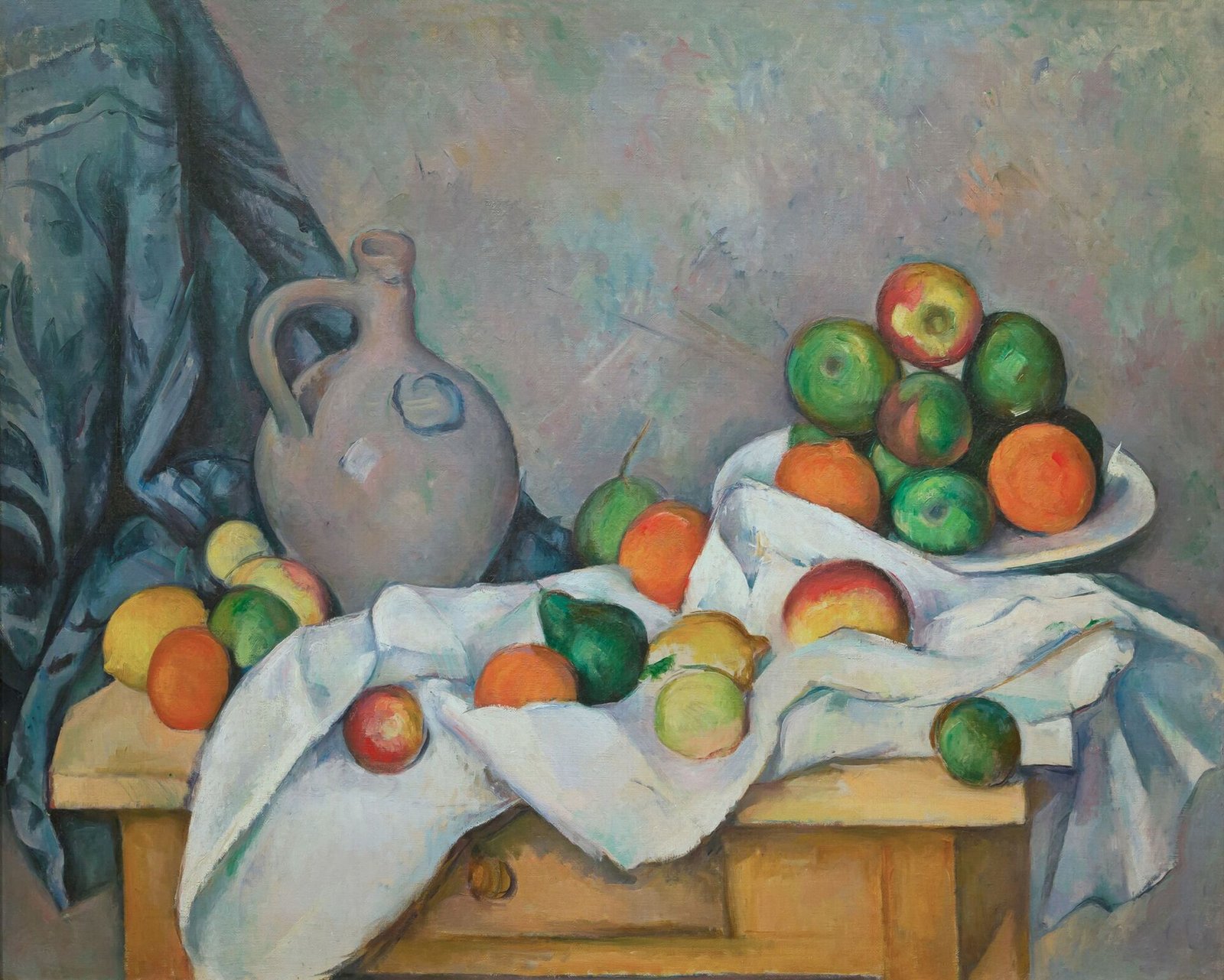
Rideau, Cruchon et Compotier, painted around 1893 by Paul Cézanne, is a carefully constructed still life. On a wooden table stand a large earthenware jug and a fruit bowl piled with apples and oranges. A curtain hangs on the left in front of a patterned wall, and a white cloth spreads across the table, with pieces of fruit set among its folds. What stands out is less the arrangement, which looks casual at first sight, than the treatment of the objects. Cézanne concentrates on outlines and on the symmetry between shapes. The jug is drawn in a way that departs from ordinary perspective, adapted to the curves of the fruit and the other elements, while each object receives its own range of carefully separated shades. This freedom with perspective reflects the painter's long interest in how the eye perceives forms from different viewpoints. He summed up the idea in a well-known remark: painting from nature is not copying the object but realising one's sensations. His brushwork and controlled distortions later fed into new directions, Cubism among them. The picture also had an exceptional market history. In 1999 it was sold at Sotheby's in New York for more than sixty million dollars, a record for a still life at auction. A second version of the same subject, painted by the artist that year, is in a private collection.
- Painter
- Paul Cézanne
- Date
- 1893
- Medium
- oil paint, canvas
- Dimensions
- 59 × 72 cm
- Museum
- Whitney Museum of American Art, New York City
- Genre
- still life
- Depicts
- lemon, pitcher, table, compote bowl, drapery, fruit, Pyrus, curtain
More works by Paul Cézanne