Les Grandes Baigneuses
Paul Cézanne, 1906
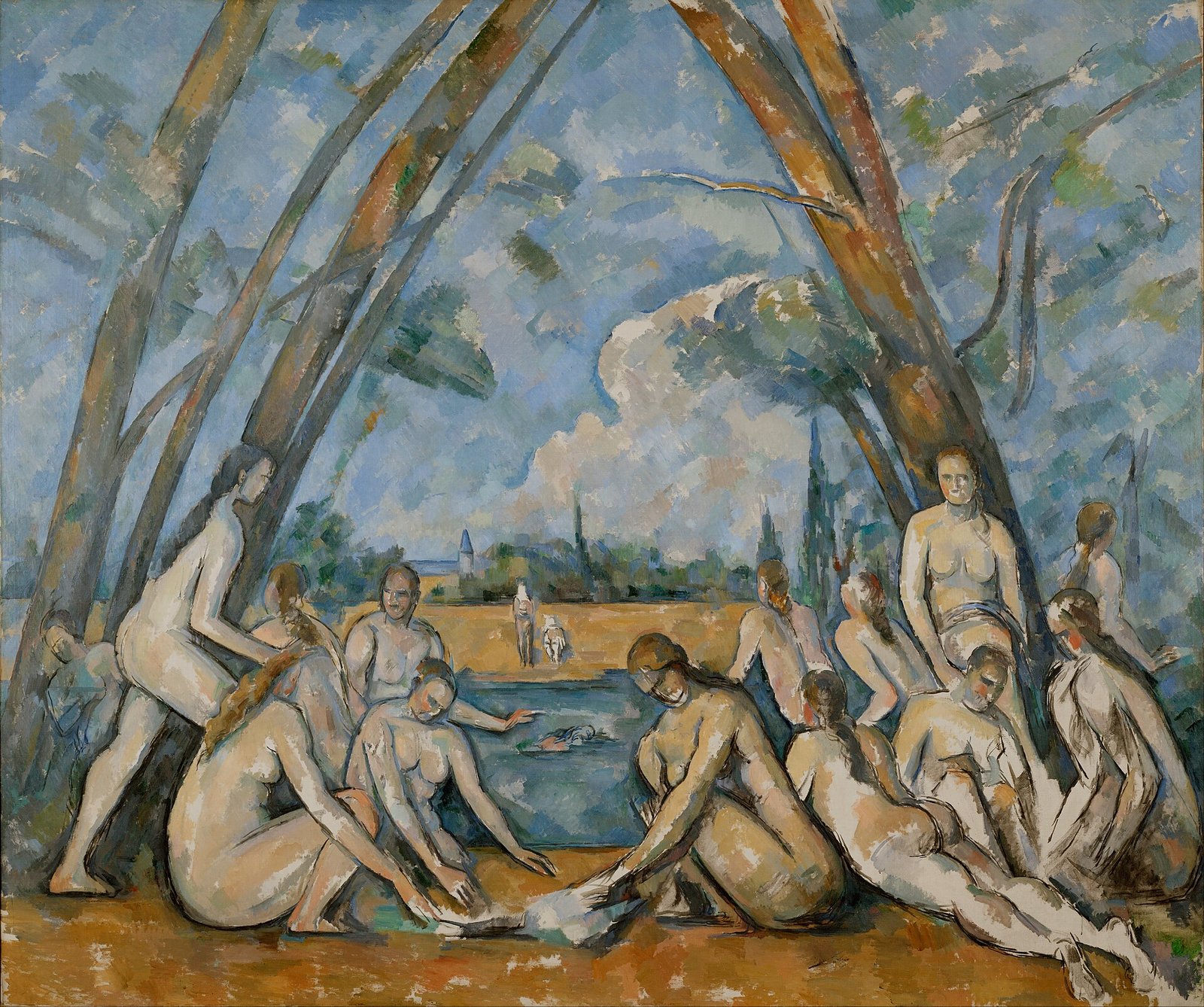
The Large Bathers is the largest canvas Paul Cézanne painted, and the one that occupied him the longest: by most accounts he worked on it for about seven years in his studio at Lauves, and it was still unfinished when he died in 1906. It belongs to a series of bather paintings he returned to across much of his career, and other versions hang in the Barnes Foundation, the National Gallery in London and the Art Institute of Chicago. It is often regarded as the most fully developed treatment of the theme and as one of the central works of modern art.
The composition balances two groups of nude figures. Between them sits a white patch that may be a dog, and a swimmer is visible in the river. In the background, two figures on the far bank and a castle close the scene, while two masses of leaning trees form a kind of vault over the bathers and open into depth at the centre. The arrangement is almost symmetrical, unusual for Cézanne, and the human forms seem to fit the triangular rhythm of the trees and water.
The palette is deliberately restrained, dominated by ochres, mauves and greenish blues. The bodies are handled more as volumes and masses than as precise anatomy, which gives the picture a notable tension and density. This simplification of form places the work on the path toward Cubism, and critics have compared its approach to older masters such as Titian and Rubens, as well as to Picasso's Les Demoiselles d'Avignon.
The painting is held by the Philadelphia Museum of Art, which acquired it in 1937. Its significance lies in showing later generations that a painting could speak to a broad public without relying on passing fashions.
- Painter
- Paul Cézanne
- Date
- 1906
- Medium
- oil paint, canvas
- Dimensions
- 210 × 251 cm
- Museum
- Philadelphia Museum of Art, Philadelphia County
- Movement
- Proto-Cubism
- Genre
- genre art, nude
- Depicts
- bathing
More works by Paul Cézanne