Christ and the Woman Taken in Adultery
Titian, 1509
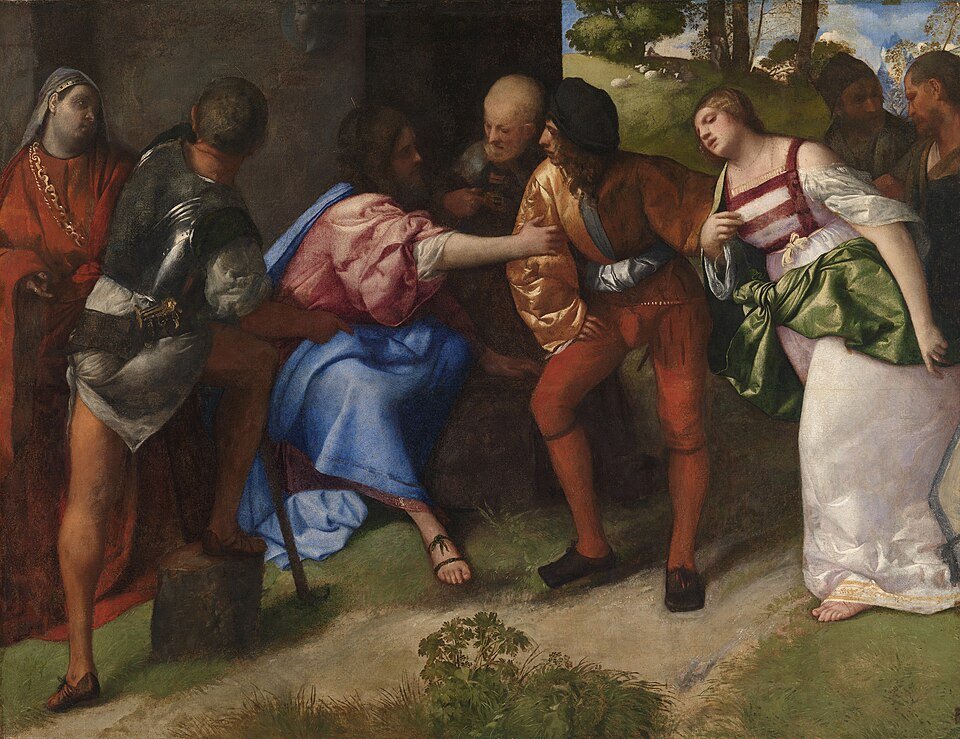
Christ and the Woman Taken in Adultery is an oil painting on canvas held at the Kelvingrove Art Gallery and Museum in Glasgow. Most scholars now regard it as an early work by Titian, probably made around 1508 to 1510, in the first years of his career and within the Venetian school of the High Renaissance. The catalogue record dates it to 1509, which places it in that same formative period.
The subject most widely accepted is the New Testament episode in which Jesus faces a woman accused of adultery, a passage in which his response to her accusers invites reflection on judgement and forgiveness. The identification, however, has not been unanimous. Johannes Wilde and others argued for the Old Testament story of Susanna and the Elders, and later readings with Daniel, a view that now has less support.
The attribution has also been debated. Names such as Bonifacio, Cariani, Romanino, Sebastiano del Piombo, Domenico Campagnola, Domenico Mancini and Giorgione have all been proposed, and the current consensus favours Titian. This range of suggestions shows how difficult it can be to separate the hands of Venetian painters of the early sixteenth century, whose styles were often very close. For this reason the work is of particular interest to those studying the beginnings of Titian, when his artistic personality was still taking shape.
- Painter
- Titian
- Date
- 1509
- Medium
- oil paint, canvas
- Dimensions
- 139 × 182 cm
- Museum
- Kelvingrove Art Gallery and Museum, Glasgow City
- Movement
- High Renaissance, Venetian school
- Genre
- religious art
- Depicts
- Jesus Christ, Jesus and the woman taken in adultery, the woman taken in adultery
More works by Titian