The Wood of the Self-Murderers: The Harpies and the Suicides
William Blake, 1824
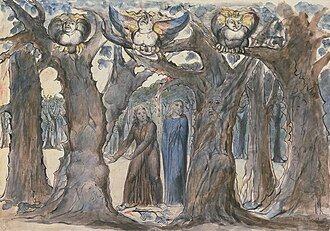
This work, made with pencil, ink and watercolour on paper, illustrates Canto XIII of Dante's Inferno, the wood of the suicides. Blake painted it between 1824 and 1827, shortly before his death in August 1827, as part of a series commissioned by his friend, the painter John Linnell. By legend Blake drew around one hundred watercolours on the poem during an illness in bed, though few were coloured and only seven were gilded.
The scene lies in the seventh circle of Hell, where the violent are punished. Suicides are encased in trees, denied eternal life, and the harpies feed on their leaves. At the time, the Catholic Church regarded suicide as at least equal to murder, and many theologians saw it as an even graver sin because it rejected the gift of life. Dante places the suicides alongside murderers, tyrants and blasphemers, and lets them speak only when their tree is broken.
Blake shows the moment when Dante tears a twig from a bleeding tree and drops it in shock on hearing a voice. The voice belongs to Pietro della Vigna, a jurist and adviser to the emperor Frederick II, who fell from favour, was imprisoned and took his own life. Dante presents his death as one that some might call heroic.
The composition blurs human figures and trunks, so the image seems to shift between tree and person. To the right a crowned man sits, and beside the travellers a female figure hangs upside down, perhaps alluding to Envy, whom Pietro blamed for his fall. The harpies, with human faces, bird bodies and female breasts, perch on the branches and embody the denial of the human form that suicide implies.
- Painter
- William Blake
- Date
- 1824
- Dimensions
- 372 × 527 cm
- Museum
- Tate, London
More works by William Blake