A Vision of the Last Judgment
William Blake, 1808
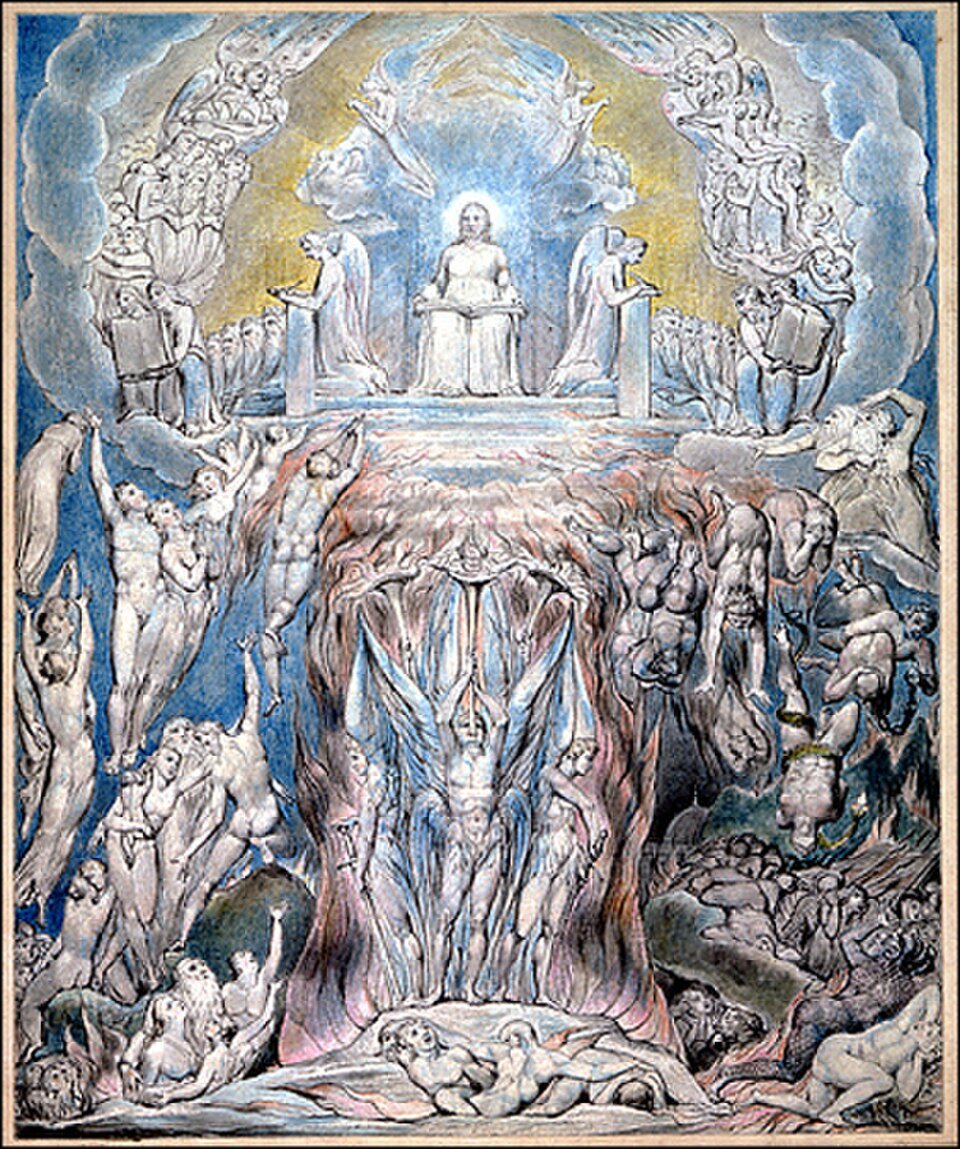
A Vision of the Last Judgment is a painting that William Blake conceived in 1808 as an expansion of his earlier design The Day of Judgment, made to accompany Robert Blair's poem The Grave. The original painting has been lost, but several watercolours, drawings and Blake's own written notes describing it have survived, which allows its content to be reconstructed in considerable detail. It was meant to be shown in a 1810 exhibition of Blair's work, which was cancelled after legal difficulties linked to other projects, and Blake's plan to include a detailed analysis in a second edition of his Descriptive Catalogue was dropped as well.
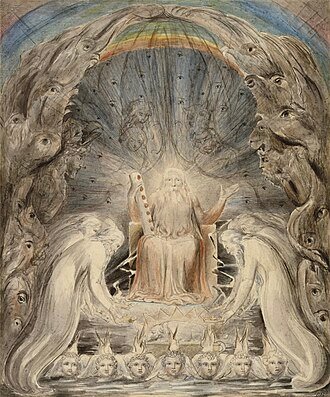
The scene shows a general resurrection. Christ sits on the Throne of Judgement beneath an open heaven, surrounded by the four Zoas and seven angels holding jars filled with the wrath of God. Above him appear a tabernacle with a cross and the Book of Life, and at the top the Christian Church is figured as a woman standing on the moon. To one side is a baptism and to the other the Last Supper, both images pointing to eternal life. The righteous rise on Christ's right, while on his left the resurrection and subsequent fall of the wicked are shown. Adam and Eve sit below Christ, close to Abraham and Moses, and beneath Moses Satan is coiled around a serpent. At the centre lies the book of death.
Blake wanted viewers to step into these images with their imagination and move among them, as if rising from their own tombs. His notes state that each figure carries an allegorical meaning according to its size, a device he otherwise distrusted, which makes this work unusual within his output. For him, Judgement was not only a final event but an inner process: whenever a person rejects evil and embraces truth, that person undergoes their own Last Judgment. This idea, close to David Hartley's notion of a pure, disinterested love of God, recurs in other works such as Jerusalem and Milton.
The painting is significant both for its iconography, which condenses Blake's visionary outlook, and for its unusual history, since it is known mainly through copies and written testimony.
- Painter
- William Blake
- Date
- 1808
- Genre
- religious art
- Depicts
- Day of Judgment
More works by William Blake