Agony in the Garden
William Blake, 2000
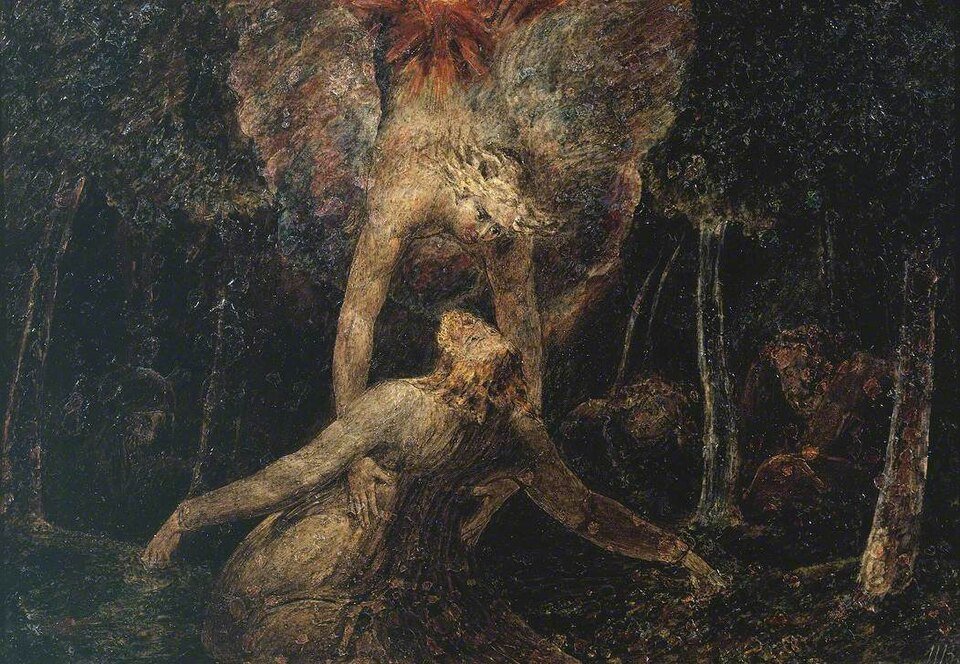
Painted around 1799-1800, this work by William Blake belongs to the series of biblical illustrations he made for his patron and friend Thomas Butts. It depicts the passage from the Gospel of Luke in which Christ, in the Garden of Gethsemane before his arrest following Judas's betrayal, suffers intense anguish. Blake shows him kneeling, arms outstretched and body leaning backwards, as if about to faint. An angel descends from a multicoloured cloud and holds him at the waist. The angel's figure, lit in reds, blues, yellows and greens, emerges from the darkness of the trees, among which three almost ghostly disciples can barely be made out.
The composition is built on vertical lines formed by the tree trunks and the angel's arms, while two inner lines converge on Christ's palms, an allusion to the nails of the crucifixion. The art historian Anthony Blunt linked the painting to other scenes in the series and read it as a reflection of a moment when Blake, having been preoccupied with evil and the duality of human nature, found hope in salvation through Christ. The light breaking into darkness would be the central motif of that message.
The materials make this work unusual within the series: the tempera is applied to tinned iron, whereas most of the others were painted on canvas and a few on copper. Blake also added cherry gum to his mixture, a technique more associated with medieval illuminated manuscripts. Today the painting is badly deteriorated, as corrosion of the metal has lifted layers of paint, and some areas, such as the greens beside Christ, were retouched around 1850.
- Painter
- William Blake
- Date
- 2000
- Medium
- iron, tempera
- Dimensions
- 27 × 38 cm
- Museum
- National Gallery, London
- Genre
- religious art
- Depicts
- angel, Agony in the Garden
More works by William Blake