Pity
William Blake, 1795
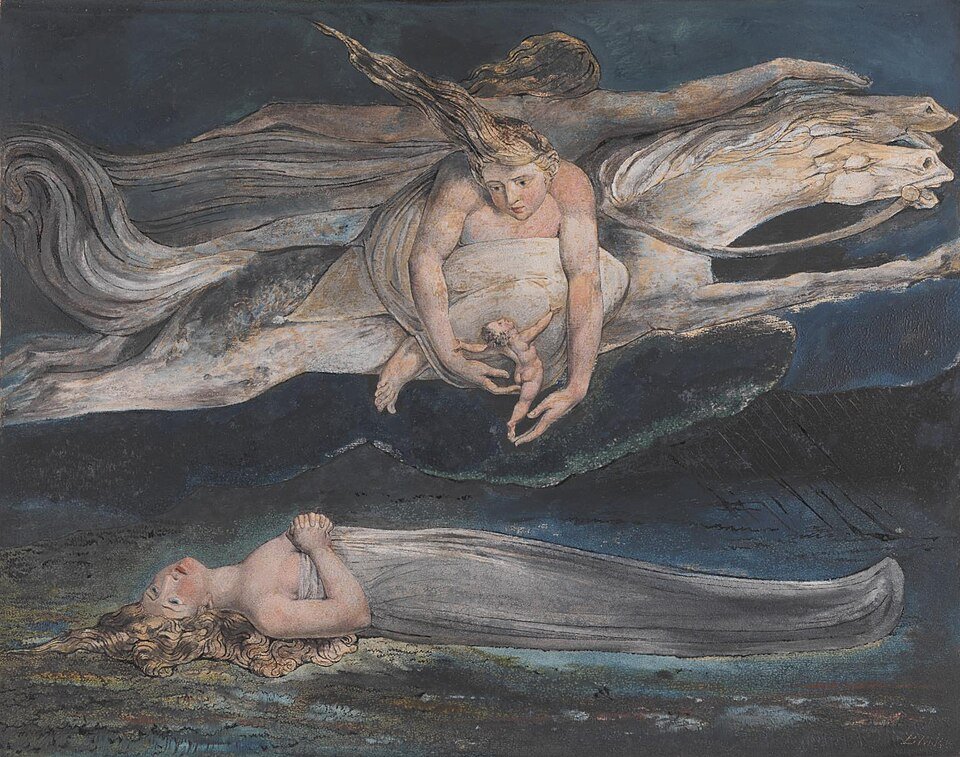
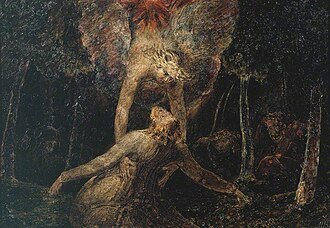
Pity is a colour print by William Blake, made around 1795 using an unusual method: an image was printed on paper from a matrix of paint on gessoed millboard, and each sheet was then finished by hand with ink and watercolour. Blake could pull up to three impressions from one matrix, so every copy is in effect a near-unique object. The work belongs to a group of pieces now called the Large Colour Prints, produced during a period when Blake drew heavily on the Bible, Milton and Shakespeare.
The image is a literal illustration of a double simile in Macbeth, in which the words "pity" and "air" appear. A winged female figure bends down to snatch a baby from its mother, while the composition is organised around a prone male body. Blake's biographer Alexander Gilchrist read the scene as a woman stooping to help a man stretched out as if given over to death. The print is often set against another Blake colour print of the same years, The Night of Enitharmon's Joy, which shows a nightmarish world; by comparison, Pity is seen as offering a possible salvation in a fallen world through compassion. Some critics, however, treat the figure as a personification of a Christian virtue that Blake himself regarded with some ambivalence.
The print survives in four versions from two matrices. The most elaborate and best known is held by the Tate in London, usually regarded as the most finished. A smaller trial impression is in the British Museum, where the reclining figure is partly covered by long grass, and further impressions are in the Metropolitan Museum of Art in New York and the Yale Center for British Art. Comparing these copies shows how the same design changed with each hand that finished it.
- Painter
- William Blake
- Date
- 1795
- Medium
- paper, ink, watercolor paint
- Dimensions
- 425 × 539 cm
- Museum
- Tate, London
More works by William Blake