Newton
William Blake, 1795
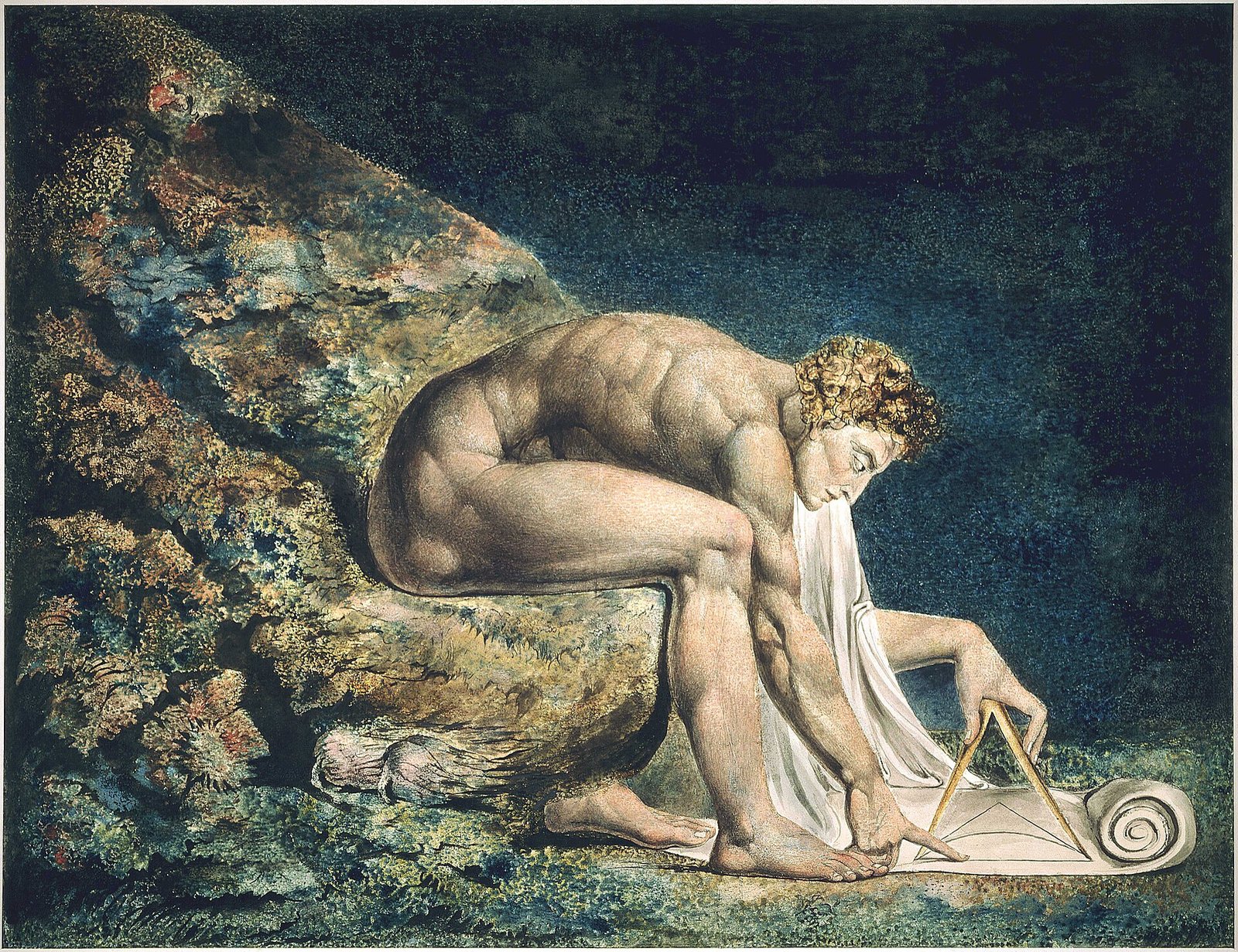
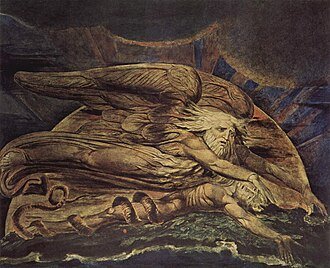
Newton is a monotype by the English poet, painter and printmaker William Blake, first completed in 1795 and reworked and reprinted in 1805. It belongs to a group of twelve "Large Colour Prints" or "Large Colour Printed Drawings" made between 1795 and 1805, a body of work that also includes his images of the biblical ruler Nebuchadnezzar. Isaac Newton is shown naked and crouched on a rocky outcrop covered in algae, apparently at the bottom of the sea. His whole attention is fixed on the diagrams he draws with a compass on a scroll. The compass is a smaller version of the one held by Urizen in Blake's The Ancient of Days, which links Newton to a figure from the artist's own mythology. The work makes most sense against Blake's deep hostility to the Enlightenment. In a note on his engraving of the classical figure Laocoön, he wrote that art is the Tree of Life and science the Tree of Death. Newton's theory of optics was especially offensive to him, since it set the "vegetative eye" apart from spiritual vision. Opposing Newton's "single vision", Blake championed his own "four-fold vision" and dismissed the "natural religion" of scientific materialism as sterile. He also rejected the deist picture of a distant God who takes no part in everyday affairs, insisting that he regularly experienced spiritual visions. For this reason Newton was placed in Blake's "infernal trinity" alongside the philosophers Francis Bacon and John Locke. The print later served as the basis for Eduardo Paolozzi's 1995 bronze sculpture Newton, after William Blake, which stands in the piazza of the British Library.
- Painter
- William Blake
- Date
- 1795
- Dimensions
- 460 × 600 cm
- Museum
- Tate, London
- Genre
- portrait
- Depicts
- compass, nudity, sitting, paper, blond hair, rock, man, Isaac Newton
More works by William Blake