The Martyrdom of St George
Paolo Veronese, 1564
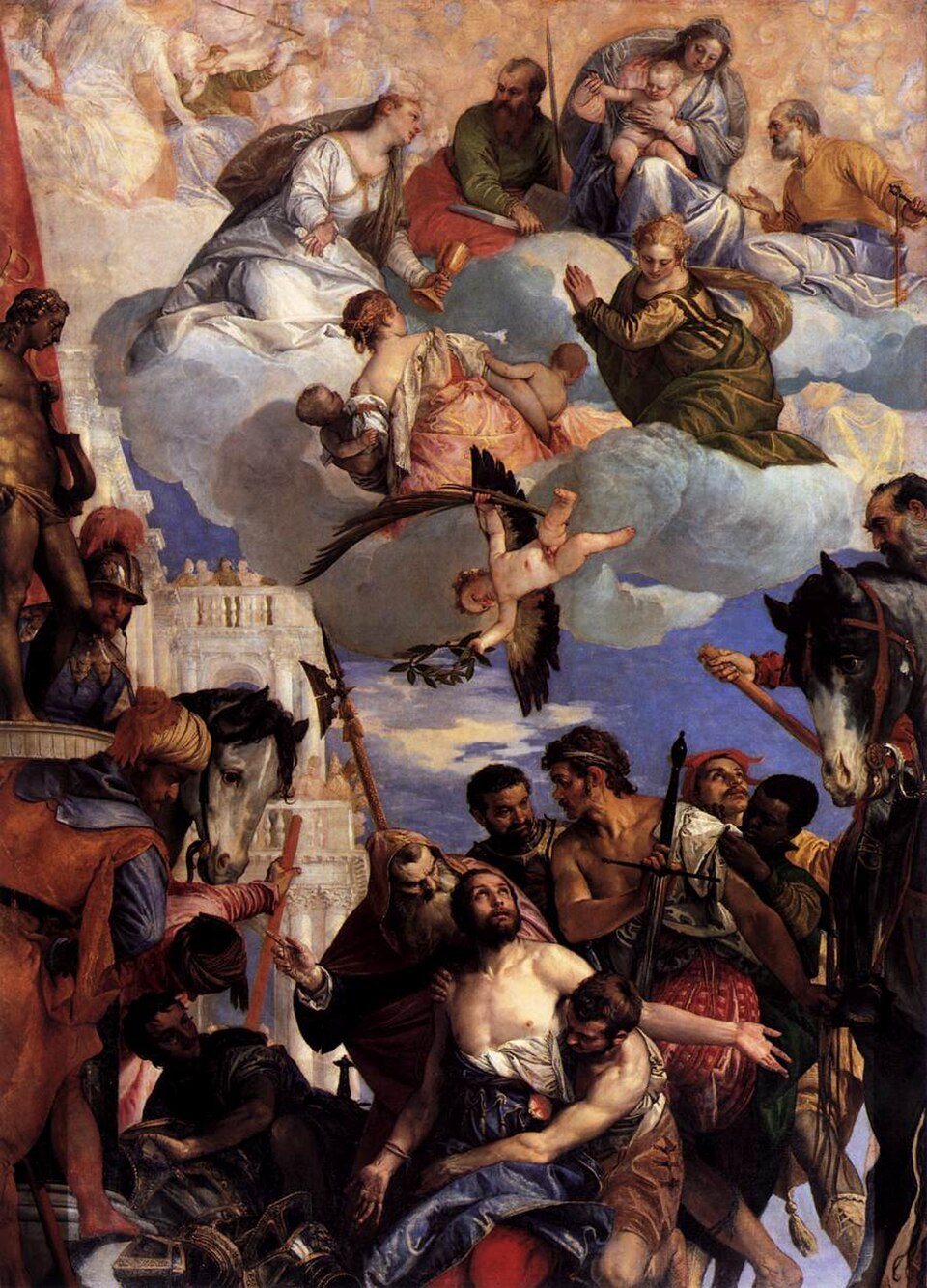
The Martyrdom of St George is an oil-on-canvas painting by Paolo Veronese. The record gives 1564, while another reference dates it to 1566, so the exact year is best treated with some caution. It depicts the martyrdom of the saint, a widely venerated figure, and was made for the high altar of the Veronese church of San Giorgio in Braida, dedicated to him, where it still hangs. Veronese painted it in Verona, his birthplace, to which he had returned to marry Elena, daughter of Antonio Badile, his former teacher. That family and professional tie places the work within the artist's local circle at that stage of his career.
The physical history of the canvas is nearly as eventful as its origins. Shortly before 1732, the Veronese scholar Scipione Maffei recorded that a decision had been taken to unpick the canvas so that an earlier, poorly executed restoration could be addressed. Maffei called the decision a heinous crime, though he did not explain why it was taken or what became of the painting afterwards. During the French occupation, the picture was taken from the church, folded for transport and sent to Paris, where it arrived in August. After Napoleon's fall it came under Austrian control and, in 1816, returned to San Giorgio in Braida following another restoration of uncertain outcome.
During the First World War the canvas was again removed, this time to Florence, to protect it from bombardment, and it went back to Verona after the conflict. In transit a large tear opened in the saint's cloak, and it was repaired under the Veronese scholar Attilio Motta. Further major restorations were carried out in 1987 and 2014. The painting therefore also records how its movements and repairs have shaped its condition today.
- Painter
- Paolo Veronese
- Date
- 1564
- Medium
- oil paint, canvas
- Dimensions
- 426 × 305 cm
- Museum
- San Giorgio in Braida, Verona
More works by Paolo Veronese


